 Olfactionary
Olfactionary Academy
A 67-chapter course modeled on the structure real perfumery institutes teach, ISIPCA, the Grasse Institute of Perfumery, Givaudan's in-house school, adapted into something you can read for free, with no lab kit required. Thirteen parts: the actual science of smell, six thousand years of history, the chemistry of raw materials, the grammar of fragrance families, the perfumer's craft, a real nose-training program based on the historic Jean Carles method, the business behind it all, functional/technical fragrance and regulation beyond fine perfumery, a family-by-family deep dive through the real raw-material palette, a composition studio walking through building real accords from a brief, and the safety science and quality-control processes a real formula has to pass before it ships, a look beyond Western fine fragrance at the attar, oud, and kōdō traditions, and further depth on history, sensory science, and musk chemistry. No prior knowledge assumed.
Realistic time commitment: reading all 67 chapters plus the quick-check quizzes and reflection exercises runs roughly 4-6 hours. The hands-on nose-training schedule in Chapter 63 is a separate, genuinely paced program, short daily smelling sessions across seven phases, that realistically takes about 12 weeks to actually complete, not something reading speed can compress.
Recently added (September 2026): spaced-repetition flashcards, a searchable glossary, hover definitions on every material link, and an in-page search box.
See a sample exam question →
Which of these is a top note, based purely on typical volatility?
Bergamot, top notes evaporate fastest and are smelled first, before the heart and base notes emerge. (Written fresh for this preview, not drawn from the live exam pool, see academy_quiz's own note on that above.)
What does IFRA actually regulate?
Usage limits and restrictions on individual fragrance materials for consumer safety, not marketing claims or trademarks. See Chapter 19 and the IFRA Standards Library in Historic Texts.
Chapter 1, Molecules, Receptors, and the Brain
Most perfumery courses start with the pyramid. This one starts a step earlier, with the actual biology, because it explains everything else. In 1991, Linda Buck and Richard Axel published a paper identifying a huge family of genes, roughly 1,000 in mice, about 350 that are functional in humans, each coding for a different odorant receptor. That discovery won them the 2004 Nobel Prize in Physiology or Medicine, and it answered a question perfumers had worked around for centuries without understanding: how does the nose tell tens of thousands of different smells apart with only a few hundred types of receptor?
The answer is combinatorial coding. A single receptor isn't dedicated to one smell, it responds, more or less strongly, to many different molecules. And a single molecule usually activates several different receptors at once, each to a different degree. What your brain perceives as "jasmine" isn't one receptor firing, it's a specific pattern across dozens of receptors simultaneously, the way a chord is a specific pattern of several notes rather than one note played louder. Axel described the brain's read on this as something like "I'm seeing activity in positions 1, 15, and 54 of the olfactory bulb, that must be jasmine."
This is also why perfumery is combinatorial in the same way. A perfumer isn't assembling smells the way you'd assemble ingredients in a recipe that stay separately identifiable, they're creating a new receptor-activation pattern that reads as a single, often entirely novel, impression. That's the biological basis for something you'll come back to constantly in this course: an accord (Chapter 24) genuinely stops smelling like its parts, because your brain is pattern-matching the combination, not listing ingredients.
One more distinction worth knowing early: orthonasal smell is what happens when you sniff something directly through your nostrils, perfume off a blotter, coffee from a cup. Retronasal smell happens when volatile molecules travel up from the back of your mouth while you're eating or drinking, which is why food loses most of its perceived "flavor" (not its taste, sweet, salty, sour, bitter, umami are a separate sense) when your nose is blocked by a cold. Most of what people call "taste" is actually retronasal smell. Perfumers work almost entirely in the orthonasal channel, but the underlying receptor biology is identical either way.
Further reading: Buck & Axel's original 1991 paper, the primary source behind this chapter.
Chapter 2, The Proust Effect: Why Smell Bypasses Logic
Marcel Proust's narrator, tasting a madeleine dipped in tea, is flooded with an entire buried childhood memory, involuntary, vivid, and far more emotionally intense than simply trying to recall the same memory on purpose. Psychologists now call this the Proust effect, and it turns out to have a specific, well-documented anatomical explanation rather than being a literary flourish.
Every other sense, sight, sound, touch, is first routed through the thalamus, the brain's central relay station, before reaching areas responsible for emotion and memory. Smell is the exception: signals from your olfactory receptors travel with far fewer intermediate stops directly into the amygdala (the brain's emotional-tagging center) and the hippocampus (central to forming long-term memories). Sight has to be processed and interpreted before it can trigger an emotional memory. Smell arrives already wired into the emotional and memory circuitry.
Researchers studying odor-evoked memories describe them with the acronym LOVER, Limbic, Old, Vivid, Emotional, Rare. Compared to memories triggered by a photo or a song, smell-triggered memories tend to reach further back (often to childhood), feel more emotionally intense, and happen less often but more powerfully when they do.
This isn't a side fact, it's the reason perfume exists as an industry at all, rather than just a hygiene product. A brief for a new fragrance (Chapter 28) is almost never written as a list of notes; it's written as a feeling, a memory, a place, a person, because the whole point of the exercise is to build something that reaches the amygdala directly. No other consumer product category is built this deliberately around a single, specific piece of neuroanatomy.
Chapter 3, The Physics of the Pyramid
A perfume isn't one smell, it's a mixture of dozens of scent molecules, all evaporating off your skin at different speeds. That's the entire reason perfumers talk about "top," "heart," and "base" notes: it's not a flavor description, it's a timeline, and the timeline is governed by a real physical property called vapor pressure, how readily a molecule turns from liquid into gas at skin temperature.
Top notes are small, light molecules with high vapor pressure, usually gone within 15-30 minutes. Citrus oils and sharp aromatics sit here. Heart notes are medium-weight, dominating from around 30 minutes to a few hours in, florals, spices, and fruit notes commonly live here, and this is usually considered a perfume's "true" character. Base notes are the heaviest, slowest molecules, woods, resins, musks, vanilla, and can last many hours, often acting as a fixative that physically slows the evaporation of everything lighter sitting on top of them.
Vapor pressure correlates closely with molecular weight, heavier molecules generally evaporate slower, which is why top notes are consistently built from small citrus terpenes and base notes from large wood and resin molecules. It's not tradition, it's chemistry. A perfume's dry-down smells warmer and less sharp than its opening for the same reason: you're smelling an increasingly narrow set of the heaviest molecules left, as everything lighter has already left the skin entirely.
One honest caveat: the pyramid is a simplification, and in practice a base note like vanilla is often present in the formula from minute one, just masked by louder top notes until they fade, what you perceive as the pyramid "unfolding" is really a complete mixture changing which parts are loud enough to notice. What a brand publishes as "the notes" is also usually a marketing simplification of a formula with far more materials in it than the three or four printed on the box. But as a mental model for predicting how a scent will change on your skin, it remains genuinely useful, and it's exactly what you'll see broken out on every perfume page on this site.
"Top notes disappear completely, then heart notes start, then base notes start." Reality: all three layers are typically present in the formula from minute one, the pyramid describes which layer is loud enough to notice at a given moment, not a sequential handoff where one layer switches off before the next switches on.
"The notes listed on the box are the real, complete formula." Reality: published notes are a marketing simplification, almost always a small fraction of the materials actually in the formula (Chapter 27), genuinely useful as a starting vocabulary, not as an ingredient list.
Chapter 4, Why It Smells Different on You
Two people wearing the same perfume genuinely smell different, and it isn't in their imagination. Skin pH, oil (sebum) production, warmth, and even diet all change how quickly different molecules evaporate and how they interact with each other on their way off your skin, drier skin tends to make a fragrance fade faster and read sharper; oilier skin holds onto and slightly softens it.
There's also a genetic layer to this, directly tied to the receptor biology in Chapter 1. Because different people carry different variants of the roughly 350 human odorant receptor genes, specific-anosmia is common and well documented, a real, measurable inability to detect one particular molecule at normal concentrations, while smelling everything else normally. The best-studied example is androstenone, a compound with a musky-urinous smell to some people, a sweet-floral smell to others, and no detectable smell at all to a large minority. You are not imagining it if a friend insists a perfume "smells like nothing" on them.
Then there's olfactory adaptation (also called fatigue): your receptors stop signaling as strongly to a smell you've been continuously exposed to, which is why you stop noticing your own perfume within about 15-20 minutes while people around you still smell it clearly. This is exactly why perfumers rarely trust their own nose on a fragrance they've been smelling all day, and why professional evaluation sessions (Chapter 31) are kept short and spaced out, often with a neutral "palate cleanser" smell, traditionally coffee beans, though the actual evidence that coffee resets your nose better than any other neutral smell is thinner than the ritual suggests, between samples.
Practical takeaway: never judge a perfume you've been wearing all day by your own nose alone, never trust a first sniff off a blotter as the final verdict, and don't be surprised when a fragrance you love reads completely differently on someone else's skin. All three are real physiology, not personal failure.
"If a friend says a perfume smells like nothing on them, they're just not paying attention." Reality: specific anosmia is real and measurable (Chapter 4), a genuine, receptor-level inability to detect one particular molecule while smelling everything else normally, not inattention or politeness.
"Everyone smells the same molecule the same way." Reality: combinatorial coding (Chapter 1) means the same molecule activates a genuinely different pattern of receptors in different people, and specific anosmias (like androstenone reading as musky, floral, or scentless depending on the person) show this isn't a rounding error, it's real, structural perceptual variation.
What did Buck and Axel's 1991 discovery identify?
What is "olfactory adaptation" (fatigue)?
Chapter 5, Egypt and the First Perfumes
The earliest perfumery wasn't cosmetic, it was religious. Ancient Egyptian temples burned incense as an offering to the gods (the word "perfume" itself is often traced to the Latin per fumum, "through smoke"), and the most famous formula to survive from this era is kyphi, a complex incense blend of resins, wine, honey, raisins, and aromatic plants that was burned in temples at sunset and was reportedly complex enough that ancient writers described the recipe in real detail, a rare case of an actual documented formula surviving from antiquity rather than just a description of the smell.
Extraction technology at this stage was crude by modern standards, mostly infusing plant matter directly into fats and oils, since true distillation hadn't been invented yet (that breakthrough is Chapter 6). Scented oils were used in mummification, in religious ritual, and among the wealthy as a mark of status, Cleopatra's reputed use of perfume as a tool of political theater, allegedly scenting the sails of her ships before meeting Mark Antony, is one of the earliest recorded examples of fragrance being used deliberately for image and influence rather than simple pleasantness.
Mesopotamia developed in parallel, the world's first named chemist on record is often cited as a woman, Tapputi, a perfume-maker mentioned on a cuneiform tablet from around 1200 BCE, who is documented distilling flowers, oil, and calamus, filtering the results, and combining them repeatedly, a genuinely early record of iterative formulation technique, thousands of years before "perfumer" was a formal profession.
Further reading: Plutarch's own account of the kyphi recipe and the Tapputi tablet.
Chapter 6, Ibn Sina and the Invention of Steam Distillation
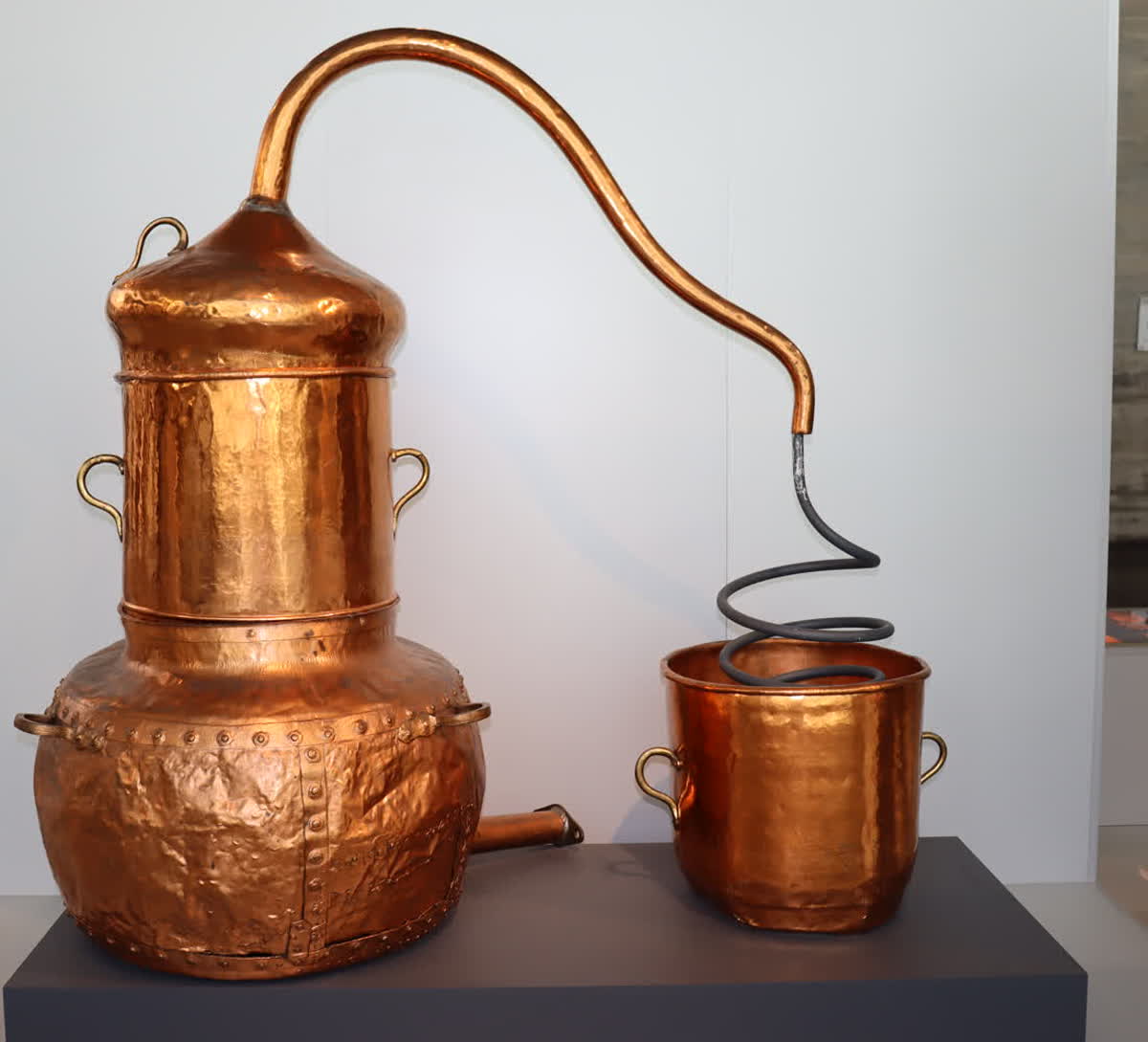
Every essential oil described in Chapter 14 exists because of one 10th-century breakthrough. Ibn Sina, known in the West as Avicenna, was a Persian polymath better remembered today for medicine, but he's also credited with refining steam distillation into something close to the process still used industrially today, improving the cooling coil of the alembic still so steam could condense more efficiently as it carried aromatic compounds out of plant material.
One of the first materials he worked with was the Damask rose. Steam-distilling rose petals produces two products at once: a concentrated essential oil (rose otto) and the aromatic water left behind (rose water), both of which became major commodities exported from Persia alongside textiles and carpets, traded as far as India and China in exchange for exotic woods, spices, and porcelain.
This is a genuinely underrepresented fact in most Western-centric perfume histories: the technology underlying "essential oil" as a category, the single most fundamental raw-material extraction method in perfumery, is a specific, dateable Islamic Golden Age invention, not a vague ancient technique that simply appeared. The basic mechanics haven't meaningfully changed in a thousand years; modern distillation equipment is more efficient and better instrumented, but it is running Ibn Sina's core process.
Rose water, the exact byproduct this chapter describes, is sold cheaply in any Middle Eastern or South Asian grocery store, usually in the baking or spice aisle. A few drops on a blotter or tissue gets you the genuine result of a 1,000-year-old process, not an approximation of it.
Further reading: Ibn Sina's Canon of Medicine, the primary source behind this chapter.
Chapter 7, Catherine de Medici's Glove
Perfumery entered European fashion through, of all things, a leather-tanning problem. Renaissance-era leather tanning used animal urine and excrement in its process, leaving even high-quality leather smelling genuinely foul. A tanner in the southern French town of Grasse, traditionally credited to a tanner named Galimard, had the idea of scenting leather gloves with aromatic oils to mask the smell.
He presented a pair to Catherine de Medici, the Florentine-born Queen of France, who had brought Italian court fashion (and its more developed relationship with perfume) with her when she married into the French royal family. She loved the gesture, scented gloves became a genuine trend at the French court, and demand for them among the aristocracy grew fast enough that Grasse's tanners began transitioning their businesses toward the more lucrative, better-smelling perfume trade.
By the time the trend faded, the transition had already happened, Grasse's tanners had effectively become perfumers, and the town's location (warm, well-watered valleys ideal for growing rose, jasmine, tuberose, and lavender at scale) meant the shift stuck permanently rather than fading with the fashion that started it. That geographic and agricultural advantage is the actual foundation of what Chapter 8 covers: Grasse becoming, and remaining for centuries, the acknowledged capital of the perfume world.
Further reading: Établissements Antoine Chiris's own Grasse trade journal.
Chapter 8, Grasse: From Tannery Town to World Capital
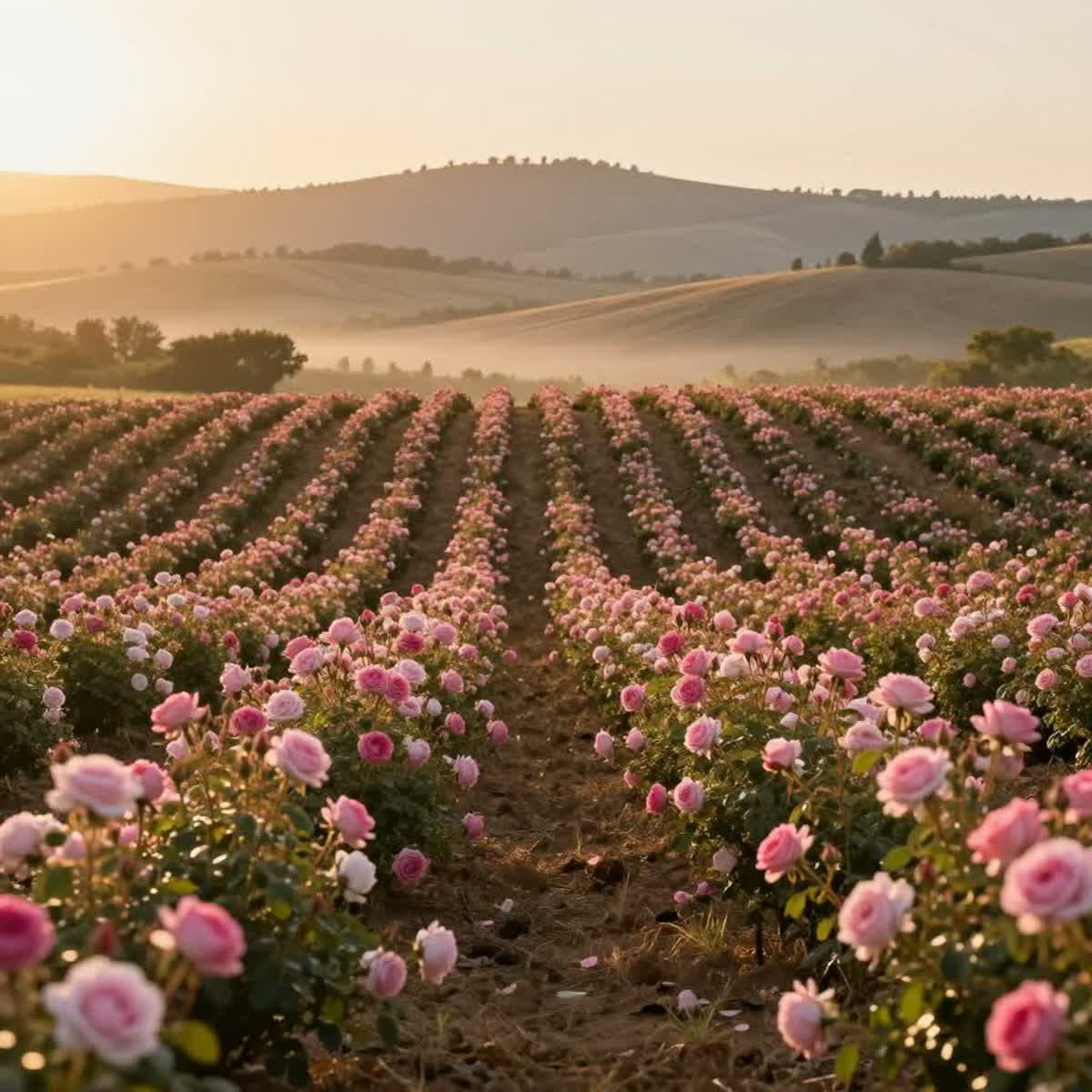
By the 18th century, Grasse's perfume trade had far outgrown the leather trade that originally birthed it. The region's climate turned out to be close to ideal for cultivating the specific flowers perfumery depends on most heavily, May rose (Rosa centifolia), jasmine, tuberose, orange blossom, and lavender at higher elevations, and by the 19th century, Grasse was unambiguously the center of the global perfume industry, a position it has never fully relinquished even as raw material sourcing globalized.
What made Grasse different from simply being "a place with good flowers" was the concentration of processing expertise that grew up around the fields, distillers, extraction specialists, and eventually the fragrance-and-flavor companies (Firmenich, Givaudan, Robertet, Mane, and others each have deep roots in or near the region) that still supply the raw ingredients and finished fragrance formulas for the vast majority of perfumes sold worldwide today, designer and niche alike, even when the bottle says Paris or Milan.
Grasse is also where the two major real-world training institutions referenced throughout this course actually sit or trace back to: the Grasse Institute of Perfumery (Chapter 40) trains perfumers directly in the town's fields and labs, and Givaudan's in-house perfumery school runs field trips there as a core part of its four-year curriculum. The rose fields Catherine de Medici's gloves indirectly created are, six centuries later, still where a meaningful fraction of the world's actual perfumers get trained.
Further reading: Chiris's Grasse trade journal and the Roure-Bertrand Fils scientific bulletin, the actual Grasse house where Jean Carles (Chapter 34) later worked.
Chapter 9, The Synthetic Revolution I: Coumarin, Vanillin, Ionone
"Synthetic" carries a bad reputation it mostly doesn't deserve, and the history explains why the industry doesn't share the stigma. Three materials, synthesized within a couple of decades of each other in the late 1800s, quietly rebuilt what perfumery was capable of.
Vanillin, first synthesized in 1874, made vanilla's characteristic scent affordable at industrial scale for the first time, real vanilla extraction from orchid pods is expensive, slow, and low-yield even today. Ionone, synthesized in 1893, gave perfumery an affordable violet scent; natural violet-flower oil had, until then, been one of the single most expensive materials in the industry, extracted in tiny quantities. Both materials didn't just cut costs, they made entire categories of fragrance commercially viable that had previously been luxuries reserved for the extremely wealthy.
Coumarin, isolated (initially from the tonka bean, later synthesized) around the same period, gave perfumery a sweet, hay-like note with no strong natural equivalent at scale, and became, alongside lavender and oakmoss, one-third of the fougère accord (Chapter 26) that would go on to define an entire century of men's fragrance. None of these three materials were trying to imitate nature perfectly; they were new tools that happened to unlock new kinds of fragrances nature alone couldn't have supplied at any price point most people could afford.
Whole tonka beans (sold online or at specialty spice shops) smell almost exactly like isolated coumarin, sweet, hay-like, faintly of fresh-cut grass and vanilla. Crack one open and smell the inside; it's the same molecule this section is describing, in its original natural source.
Further reading: the vanillin and ionone synthesis milestones.
Chapter 10, The Synthetic Revolution II: Musk Discovered by Accident
Perhaps the strangest origin story in perfumery chemistry: synthetic musk wasn't invented by anyone trying to invent a fragrance material at all. In 1888, a German chemist named Albert Baur was attempting to develop more powerful explosives based on TNT chemistry, nitrating aromatic compounds in search of better performance. One of his nitrated compounds turned out not to be a useful explosive, but it had an unmistakably powerful, warm, musky smell.
Baur recognized the commercial opportunity and pivoted, patenting what became known as "Musk Baur," and later Musk Ketone, through further nitration chemistry in 1894. This class of materials, nitro musks, became the industry's dominant musk source for most of the 20th century, entirely replacing the earlier practice of sourcing musk from the musk deer, an animal now protected worldwide, making synthetic musk not just cheaper than the natural version but the only ethical option remaining.
Nitro musks themselves were later phased out for environmental and safety reasons (some showed persistence and bioaccumulation concerns), replaced by newer chemical classes, polycyclic and macrocyclic musks, that make up the "clean," "white musk" character common in modern fragrance. But the founding fact remains genuinely striking: one of perfumery's most important and enduring material categories exists because a 19th-century explosives chemist noticed his failed weapon smelled interesting.
You don't need a perfume counter for this one, smell a load of laundry straight out of your own dryer. Most detergents and fabric softeners are built around modern "clean," "white musk" synthetics, the direct descendants of what Baur stumbled into in 1888.
Further reading: the synthetic musk discovery milestone.
Chapter 11, Case Studies: No. 5 and Shalimar
Chanel No. 5 (1921) is famous for one specific technical decision: perfumer Ernest Beaux used an unusually large overdose of aldehydes, synthetic molecules with a sparkling, almost abstract, slightly waxy-metallic quality, in the top notes. Used at normal levels, aldehydes add a subtle lift to a floral bouquet; used at the concentration Beaux chose, they dominate the opening so heavily the perfume doesn't smell like any single flower, but like "perfume" as an abstract idea. Coco Chanel reportedly chose the fifth sample she was shown, which is where the name comes from.
Shalimar (Guerlain, 1925) is considered the founding fragrance of the entire "oriental"/amber family. Jacques Guerlain built it around a bergamot opening over an iris heart, but its defining move was pushing a huge dose of vanilla, using the synthetic ethylvanillin, which reads as stronger and sweeter than natural vanillin, against smoky, resinous base notes. That contrast between bright bergamot and heavy, sweet vanilla-amber became the template an entire fragrance family was later named after and built to imitate. The name itself comes from the Shalimar Gardens in Lahore, built by Mughal emperor Shah Jahan as a symbol of eternal love, the same emperor behind the Taj Mahal.
Notice the pattern in both: neither is remembered for using exotic ingredients nobody else had access to. Both are remembered for one deliberate, unusual proportion decision, overdosing a material everyone else used sparingly. That's a recurring theme across perfumery history: technique and proportion, not rare materials, tend to be what actually creates a landmark scent.
Chapter 12, The Fougere Century and the Aquatic 90s
Houbigant's Fougere Royale (1882) is generally credited as the first fougere, French for "fern-like," despite ferns having almost no scent of their own, the name describes an abstract impression the accord (lavender, coumarin, oakmoss) creates rather than a literal ingredient. That accord went on to define men's fragrance for roughly a century, forming the backbone of most classic aftershaves and barbershop colognes well into the late 20th century, largely because it reads as unambiguously "masculine, clean, sharp" to generations of consumers raised on it.
The 1990s brought a genuine stylistic break: the rise of aquatic/marine fragrances, driven substantially by the introduction of synthetic materials like Calone (a marine-melon-ozonic molecule with no direct natural equivalent) that could evoke sea spray and wet stone in a way no natural material really could. Davidoff Cool Water (1988) and Giorgio Armani Acqua di Gio (1996) are usually cited as the commercial landmarks that took the aquatic style mainstream, and for much of the following decade it became the dominant style in mass-market men's fragrance, arguably the aldehyde revolution's closest 20th-century rival for reshaping an entire era's dominant smell.
Both movements share a structural lesson worth carrying forward: a genuinely new fragrance category, historically, has almost always been unlocked by a new material or technique becoming available, natural ingredient supply alone rarely explains why an entire decade smells the way it does.
Chapter 13, The Niche Era and Where Perfumery Stands Today
From roughly the late 1990s onward, a "niche" segment grew alongside mainstream designer perfumery, smaller houses (Serge Lutens, Le Labo, Byredo, Maison Francis Kurkdjian among the most influential) releasing scents in smaller batches, often crediting the perfumer by name (a real departure from decades of anonymous in-house noses), spending comparatively little on advertising, and charging more per bottle to match. Niche didn't replace designer fragrance commercially, designer and celebrity fragrance still dominate total sales volume, but it created real space for unconventional, technically ambitious, and sometimes deliberately uncommercial compositions that mass-market houses had stopped taking risks on.
The 2010s and 2020s have layered several more forces on top: a strong "gourmand" turn across both niche and mainstream (edible, dessert-like notes moving from a novelty into a default direction), a sustained wave of "clean," minimal-note fragrances marketed around a single dominant material (a specific "salt," a specific "musk"), and growing regulatory pressure (Chapter 19) continuing to force reformulation of decades-old classics as allergen science evolves.
The through-line across all thirteen chapters of this history: perfumery has repeatedly been reshaped less by changing taste in isolation than by new tools, a distillation technique, a synthetic molecule, a regulatory limit, becoming available or unavailable, and the industry's best creative work has consistently come from perfumers who understood the tool well enough to push it somewhere unexpected.
Which historical figure is credited with refining steam distillation into something close to its modern industrial form?
What specific technical decision defines Chanel No. 5 (1921)?
Chapter 14, Extraction Methods, in Depth
Steam distillation (Chapter 6) passes steam through plant matter, carrying volatile oils with it; the vapor is condensed and the oil separated from the resulting water. It remains standard for robust materials like lavender, citrus peel, and most herbs.
Solvent extraction produces absolutes: a solvent washes over plant material to pull out a waxy "concrete," which is then further processed with alcohol to isolate the true scent compound. This gentler method captures delicate florals (jasmine, tuberose) that heat-based steam distillation would damage or destroy. Enfleurage is the historic ancestor of this technique and far more labor-intensive: fresh flower petals are pressed into layers of purified fat, which absorbs their scent over repeated changes of petals, before the scented fat is washed with alcohol to extract the final material. It's almost entirely obsolete commercially, modern solvent extraction is faster and cheaper, but a handful of houses still practice it for prestige jasmine and tuberose lots as a marketing and quality statement.
CO2 extraction uses pressurized carbon dioxide as a solvent instead of a chemical one, at low temperature, producing a scent profile often considered closer to the living plant than steam or traditional solvent methods, though it remains more expensive and used more selectively.
A more recent addition to the toolkit is headspace technology: rather than extracting material from the plant at all, a sealed chamber captures the actual volatile molecules the living plant releases into the air around it, which are then analyzed by GC-MS (Chapter 31) so a perfumer can attempt to recreate the profile synthetically. It's the closest modern perfumery gets to capturing the scent of a flower too rare, too fragile, or too low-yielding to ever extract commercially, orchids and certain lilies are common headspace subjects precisely because they can't be extracted any other economical way.
Chapter 15, Natural Materials by Family: A Systematic Survey
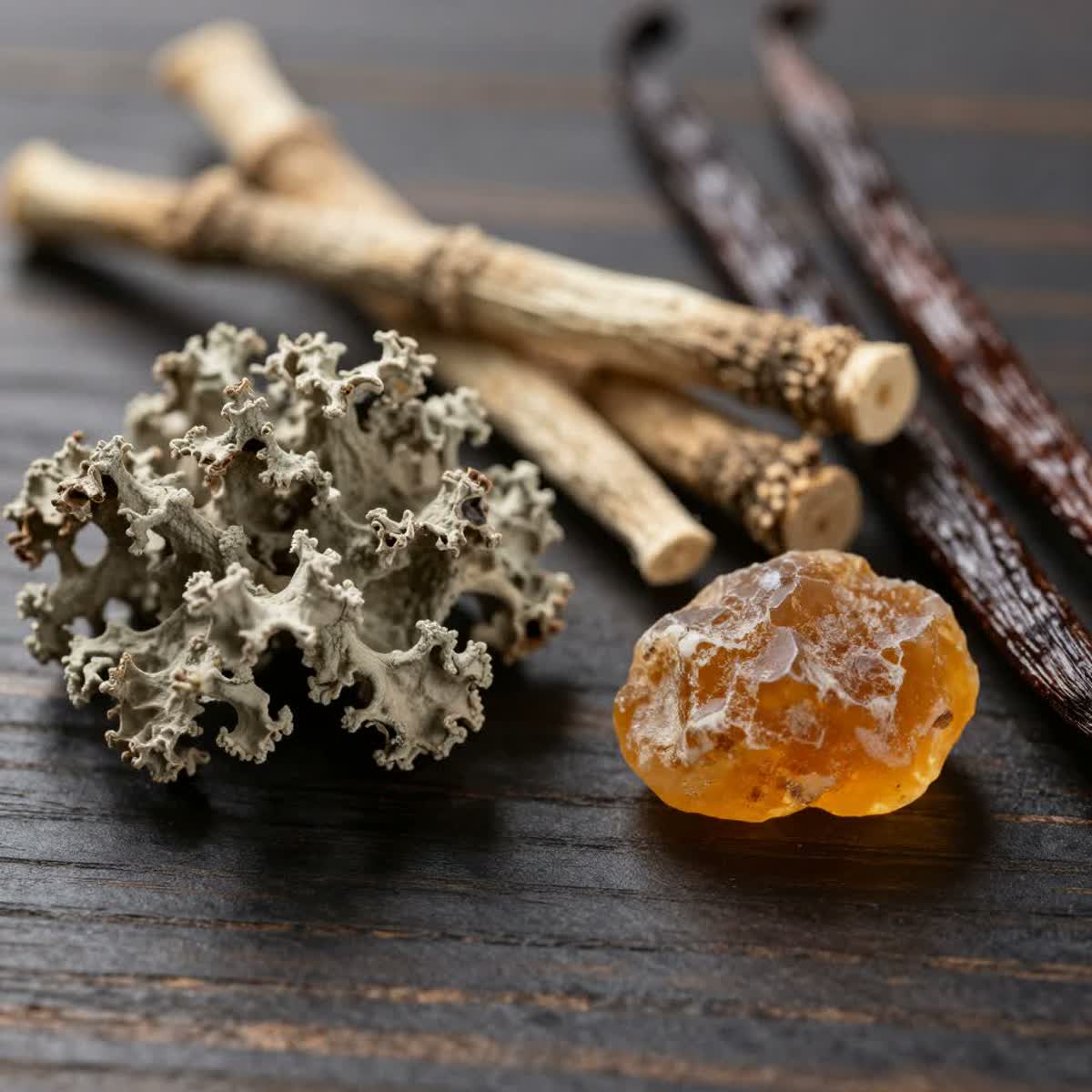
Real institute training (the Grasse Institute's raw-materials module especially) organizes natural materials the way a botanist would rather than the way a marketer would, by what part of the plant, or what kind of organism, they come from, because that predicts a lot about their character before you even smell them.
Flowers (rose, jasmine, tuberose, ylang-ylang, orange blossom) give the richest, most complex florals but are typically the most expensive materials in perfumery per kilo, since flower petals yield very little oil relative to their mass and are often hand-harvested. Fruits mostly contribute at the citrus peel level (bergamot, lemon, orange), most non-citrus "fruit" notes in perfumery are actually synthetic constructions (Chapter 17), since fruit flesh rarely yields a usable essential oil. Leaves and stems (petitgrain, violet leaf, galbanum) tend toward green, bitter, sharp characters. Woods (sandalwood, cedar, vetiver, technically a root, but grouped here by character) supply the grounding, warm base materials perfumery depends on most heavily. Resins (frankincense, myrrh, labdanum, benzoin) are tree exudates, tapped like sap, and supply warm, sticky, long-lasting base materials that have been valued since antiquity (Chapter 5) specifically for their longevity on skin.
A last, historically important category is animalics, musk (from the musk deer), civet (from the civet cat), ambergris (a rare whale intestinal byproduct found washed ashore), and castoreum (from beaver glands). All four were once foundational to perfumery for their warm, skin-like, fixative qualities, and all four are now sourced almost entirely from synthetic or ethically-sourced alternatives, musk deer and civet extraction are now restricted or banned in most markets on animal-welfare grounds (Chapter 20), and genuine ambergris, while not from an endangered source in the same way, is now rare enough that synthetic ambroxan has effectively replaced it in nearly all commercial perfumery.
Vetiver and patchouli essential oils are both cheap and widely sold at health-food stores and aromatherapy shops, a couple of drops on a blotter gives you two of perfumery's core "woods and roots" materials in their raw, undiluted form, exactly as a perfumer's organ would hold them.
Further reading: Sawer's Odorographia and Guenther's The Essential Oils, both organized by raw-material family, exactly like this chapter. For real depth on each family this chapter only introduces, Part IX (Chapters 44-50) goes back through citrus, florals, rose and violet, woods, resins, animalics, and spices one at a time.
Chapter 16, The Chemistry of Scent, in Plain Language
You don't need a chemistry degree to get real value from knowing a handful of molecular "shapes" (chemists call them functional groups) that show up constantly across perfumery materials, because materials sharing a functional group tend to share family traits in character, even across totally different plants.
Esters are formed when an acid and an alcohol combine, and they are perfumery's fruit family almost without exception, benzyl acetate (jasmine's core note), isoamyl acetate ("banana oil"), and most other fruity smells you can name are esters. Aldehydes carry a distinctive sparkling, sometimes waxy or metallic quality at low doses, this is the functional group Ernest Beaux overdosed to create Chanel No. 5's signature opening (Chapter 11). Terpenes are perfumery's most abundant natural building block, found in nearly every citrus and pine-family material, limonene (citrus), pinene (pine), and myrcene (hops, bay) are terpenes, and their light molecular weight is exactly why terpene-rich materials dominate top notes (Chapter 3).
Lactones are ring-shaped molecules that read almost universally as creamy, coconut-, or peach-like, the entire "peach skin" and "coconut" family in modern perfumery runs on this one functional group. Phenols carry sharper, often medicinal, smoky, or spicy qualities, eugenol (clove) and guaiacol (smoky, whisky-like) are phenols. Ketones are a broad, varied group, but include some of perfumery's most prized and expensive materials, the damascones and ionones (violet, rose-adjacent) are ketones.
The practical payoff: once you know jasmine's core note and banana oil are both esters, or that clove and smoky-whisky notes are both phenols, you start predicting how unfamiliar materials will smell before you've ever encountered them, exactly the skill the Jean Carles method (Chapter 34) is built to train, just approached here from the chemistry side rather than the pure-nose side.
Last reviewed: August 2026.
Chapter 17, Synthetic Aroma Chemicals: A Practical Toolkit
Modern perfumery is, in practice, almost always a blend of natural and synthetic materials, pure-natural perfumes are a small, deliberately marketed niche, not the industry default, and haven't been for well over a century (Chapters 9-10 cover why). Synthetics exist for several distinct reasons that are worth separating out, because "synthetic" gets used as if it's one category when it's really several.
Some synthetics are identical copies of a molecule that also occurs in nature, vanillin, geraniol, linalool, made in a lab because it's cheaper, more consistent, and doesn't depend on unpredictable harvests. Others are economical substitutes approximating a natural material's character at a fraction of the cost, synthetic musks standing in for animal musk being the clearest example. A third category is genuinely novel: molecules like Iso E Super, Hedione, or Ambroxan have no direct natural equivalent and unlocked entirely new textures, the "clean laundry" musk-and-aldehyde accord common in modern fresh fragrances has no flower or plant behind it at all; it's a purely synthetic invention that simply didn't exist as a smell before the chemistry did.
Fragrance houses maintain proprietary "captive" molecules, synthetics only they can legally use, patented and exclusive for a period, as a genuine competitive edge; a distinctive modern fragrance often owes its signature not to a rare natural ingredient but to a captive molecule no competitor has access to yet. This is a meaningfully different economics than natural-ingredient scarcity, and it's part of why the largest fragrance houses (Firmenich, Givaudan, IFF, Symrise) invest heavily in in-house chemistry research rather than simply sourcing better flowers.
Further reading: Parry's Chemistry of Essential Oils and Artificial Perfumes, Vol. II, dedicated specifically to isolated and synthetic aroma chemicals.
Last reviewed: August 2026.
Chapter 18, Volatility, Revisited
Chapter 3 introduced vapor pressure as the physical property behind the top/heart/base pyramid. Perfumers use a more precise, working version of this idea called substantivity, a practical measure of how long a material remains detectably present on a test strip or skin, which correlates with but isn't identical to raw vapor pressure, since substantivity also depends on how a material interacts with skin oils and with other materials around it.
Professional formulation often groups materials into rough volatility tiers rather than just three pyramid layers, something closer to five or six bands from "extremely fleeting" (some green, aldehydic top notes, gone in minutes) through to "near-permanent fixatives" (certain musks and woods, technically still detectable days later at a molecular level even if imperceptible to a human nose by then). This is one of the real, practical differences between how a hobbyist thinks about the pyramid and how a working perfumer formulates against it, the three-layer model taught in Chapter 3 is the right starting mental model, but actual formulation software and reference charts work in finer gradations.
One counterintuitive consequence: a material's raw evaporation rate in isolation isn't always identical to how it behaves inside a finished formula. Materials can slow or speed each other's apparent evaporation once blended, part of why fixation (Chapter 30) is a real, deliberate technique rather than just "add heavy stuff at the end," and part of why the same aromatic material can smell like it lasts a different amount of time depending entirely on what it's blended with.
Chapter 19, IFRA, Allergens, and Restricted Materials
The fragrance industry's own safety body, IFRA, publishes binding usage limits for individual materials based on safety research, how much of a given ingredient is allowed in a finished product, based on risk of skin sensitization, allergy, or other harm. Essentially the entire legitimate industry follows these limits, and they're the real reason vintage perfumes often smell different from their modern reissues; it's rarely that a brand cut corners.
Oakmoss is the clearest case study: central to the chypre accord (Chapter 26) since Coty's original Chypre de Coty in 1917, its allowed concentration has been sharply cut over the decades due to two specific sensitizing compounds within it (atranol and chloroatranol), forcing the entire chypre family to be substantially rebuilt around modified, low-atranol oakmoss extracts or synthetic substitutes that approximate the mossy-earthy character without the same allergen load. Coumarin (Chapter 9) faces newer restrictions as an EU-declared allergen requiring on-label disclosure above certain thresholds, directly affecting the fougere accord it helped found. Musk materials have had several full generational replacements, nitro musks (Chapter 10) phased out for environmental persistence, followed by ongoing scrutiny of some polycyclic musks on similar grounds.
In the EU specifically, a list of officially declared fragrance allergens must be printed on packaging if present above a set threshold, which is why you'll sometimes see ingredient-style text like "Linalool" or "Limonene" on a perfume box. Those aren't the perfume's actual formula (which stays a trade secret, typically known in full only to the perfumer and a small internal team); they're specific, legally mandated allergen disclosures, and a perfume can list only two or three such names while still containing dozens of other materials that simply don't require individual disclosure.
IFRA is worth remembering as the industry's own voluntary safety standard, not a government body, real, separate government regulation also applies on top of it, and doesn't always line up with it exactly. Chapter 43 covers that broader regulatory picture, REACH, national cosmetic law, and why a formula sometimes has to be adjusted per market to stay compliant everywhere it's sold, in depth.
Further reading: the current IFRA Standards Library, not historical, but the living rulebook this chapter describes. See the real, current lists of materials prohibited or restricted in this site's own directory.
Last reviewed: August 2026, regulatory content changes as IFRA issues new amendments; check the linked Standards Library for anything more recent.
"IFRA-restricted means banned or illegal." Reality: restricted means concentration-limited, not banned, IFRA has a genuinely separate "prohibited" category for materials that can't be used at all; the large majority of restricted materials (like oakmoss) are still legitimately used every day, just under a specific limit.
"Vintage perfumes were reformulated because brands got cheap." Reality: the real reason vintage perfumes often smell different from modern reissues is IFRA-driven safety reformulation, not cost-cutting, a distinction worth defending the next time someone claims a brand "ruined" a classic to save money.
Chapter 20, Sustainability and Sourcing Today
Several of perfumery's most iconic natural materials are under real, ongoing pressure. Sandalwood has been overharvested across parts of its native range (particularly India) to the point of export restrictions, pushing the industry toward Australian sandalwood species and plantation-grown sources with longer maturation cycles. Natural musk from the musk deer and civet from the civet cat are now restricted or banned across most markets on animal-welfare grounds (Chapter 15), essentially all "musk" and "civet" in modern commercial perfumery is synthetic, a complete category replacement that happened gradually enough most consumers never noticed it occur.
Vanilla presents a different kind of pressure entirely: real vanilla is genuinely labor-intensive to produce (each orchid flower must be hand-pollinated, and the pods cured for months), making supply chronically unstable and price-volatile, a bad harvest in Madagascar, which supplies the large majority of the world's natural vanilla, can spike global vanilla prices dramatically within a single season, which is part of why synthetic vanillin (Chapter 9) remains dominant in mass-market perfumery even a century and a half after its invention.
The industry's own framing of synthetics has genuinely reversed over the past few decades: increasingly, synthetic materials are positioned as the responsible choice rather than the cheap one, since they remove pressure from wild plant and animal populations, don't depend on unpredictable harvests, and can often be produced with a smaller environmental footprint than large-scale natural cultivation and extraction. That's a real reversal from how synthetics were marketed as recently as the 1990s, when "100% natural" was the dominant premium claim.
Which extraction method is the historic ancestor of solvent extraction, pressing flower petals into layers of purified fat?
Which two specific compounds within oakmoss led to its usage being sharply restricted by IFRA?
Chapter 21, Comparing Classification Systems
There is no single official fragrance classification, several competing systems exist, and knowing more than one is genuinely useful, since sources you'll encounter online use different ones without necessarily saying so.
The most widely used consumer-facing system is Michael Edwards' Fragrance Wheel, first published in 1992 and still updated today across a database of more than 60,000 classified fragrances. It organizes everything into four primary families, Floral, Amber (formerly labeled "Oriental"), Woody, and Fresh, arranged in a circle, each split into subfamilies (Floral Amber, Soft Amber, Aromatic, Citrus, Water/Aquatic, and more), positioned so that neighboring segments share real olfactory similarity and opposite segments are the most different from each other. It's designed explicitly as a retail tool, to help someone who likes one perfume find genuinely similar ones nearby on the wheel.
The Grasse Institute of Perfumery teaches a different, more historically-rooted structure organized around seven "genealogies", aromatic, citrus, chypre, floral, fougere, oriental, and woody, each treated as a lineage with its own founding fragrances and evolution over time, closer to how a perfumer traces where a technique or accord actually came from than how a retailer sorts inventory.
This site's own family pages lean closer to the traditional/genealogical model, but it's worth holding both mental maps at once: Edwards' wheel for practical "if you like X, try Y" navigation, and the genealogical model for understanding why a family exists and what came before it. Chapters 22-23 work through both traditions' major families in depth.
Further reading: Jellinek & Calkin's Perfumery: Practice and Principles, the standard academic text on formulation architecture and classification.
Chapter 22, Deep Dive: Floral, Woody, Fresh
Floral is perfumery's largest and oldest family by far, built around real or imagined flower notes. It splits meaningfully by structure: "soliflore" perfumes center almost entirely on one flower (classic rose or violet soliflores), while most modern florals are bouquets blending several florals into a composite impression that may not correspond to any single real flower at all. Sub-styles worth knowing include floral-fruity (the dominant style in mass-market women's perfumery since the 2000s), floral-woody, and floral-aldehydic (Chapter 11's No. 5 lineage).
Woody centers on materials like sandalwood, cedar, and vetiver, generally grounding and warm rather than sharp. A meaningful modern split exists between "dry woods" (cedar, vetiver, sharper, drier) and "creamy woods" (sandalwood, and the synthetic materials built to mimic or extend it, Chapter 17), the difference between these two textures is often what separates a masculine-coded woody fragrance from a softer unisex one, more than any single named ingredient.
Fresh (citrus, green, and aquatic scents) is Edwards' broadest, most heterogeneous family, it groups things as different as a sharp lemon cologne and an aquatic musk mainly by shared function (light, clean, easy to wear) rather than shared raw materials. This is the family where the aquatic 90s (Chapter 12) sits, and it's also the family where you'll find the most purely synthetic construction, since genuinely "clean" and "ozonic" smells have essentially no natural raw-material equivalent at all.
For "woody," compare an unsharpened cedar pencil to a sandalwood incense stick, unlit, the pencil gives you dry, sharp cedar; the incense gives you warm, creamy sandalwood. That contrast is the entire "dry woods vs. creamy woods" distinction this section describes, in two objects you probably already own.
Chapter 23, Deep Dive: Amber, Chypre, Fougere
Amber (still often called "Oriental" in older sources, though the industry has been moving away from that term) is built around resins, vanilla, and spice, rich and warm, founded by Shalimar (Chapter 11) and still one of the most reliably recognizable, love-it-or-hate-it families. The core "amber accord", usually labdanum, vanilla, and benzoin blended together, smells almost nothing like any single one of its three components in isolation, a clean real-world example of accord chemistry (Chapter 24) in action.
Chypre, French for "Cyprus," traces to Francois Coty's 1917 Chypre de Coty and is built on a structure of bergamot, oakmoss, and labdanum that reads as mossy, earthy, and slightly bitter, historically one of perfumery's most respected and technically demanding families, and also the family hit hardest by IFRA oakmoss restrictions (Chapter 19), forcing near-total reformulation of the classics that defined it.
Fougere, literally "fern-like", is built from lavender, coumarin, and a mossy-woody base, tracing to Houbigant's Fougere Royale (Chapter 12) and defining most classic men's aftershaves for a century. It remains, alongside chypre, one of the two families most explicitly named after an accord rather than a single ingredient or mood, a useful reminder that "family" and "accord" (Chapter 24) are closely related but not identical concepts.
Earl Grey tea is genuinely flavored with real bergamot oil, smell a dry tea bag before brewing and you're smelling the same citrus top note that opens most chypre and fougere fragrances, straight from the actual raw material.
Further reading: real 1892 chypre-style formulas in the Historical Formula Index, worth comparing against the bergamot-oakmoss-labdanum skeleton above, since neither historic formula uses it.
Chapter 24, What Is an Accord?
An accord is a specific combination of materials, blended in specific proportions, that stops smelling like its individual parts and reads as one new, unified impression, the same way a chord in music is more than three separate notes played at once, and the same biological principle as the combinatorial receptor coding covered in Chapter 1.
Perfumers build and reuse accords the way a cook builds and reuses a base sauce. The classic chypre accord, bergamot, oakmoss, and labdanum, reads as a single mossy-citrus impression, not three ingredients. The fougere accord became the entire backbone of men's aftershave for a century. The amber accord is the warm, resinous base under most oriental perfumes, built from materials that individually smell quite different from the final blend.
This is why two perfumes can share almost no materials in common and still smell similar, or share several materials and smell nothing alike, the accord, the specific ratio, is what actually determines the outcome. Learning to recognize accords rather than individual notes is the real jump from hobbyist to informed enthusiast, and it's exactly what the Jean Carles method (Chapter 34) is designed to train systematically rather than by accident.
Further reading: Piesse's Odophone, the actual "chord" metaphor this chapter opens with, from the primary 1891 source, not a paraphrase of it.
"If two perfumes share the same listed top note, they'll smell similar." Reality: shared materials don't guarantee a shared accord, the specific ratio is what actually determines the outcome, which is exactly why two fragrances can share almost no materials and still smell alike, or share several and smell nothing alike.
"An accord is just a fancy word for an ingredient list." Reality: an accord specifically stops smelling like its individual parts and reads as one new, unified impression, a list of materials with no fixed ratio isn't an accord at all, just a shopping list.
Chapter 25, Horizontal vs Vertical Accords
Perfumery training (this distinction is explicit in the Natural Perfumery Institute's module structure, among others) separates accord-building into two directions, and both matter for different reasons.
A horizontal accord combines several materials operating at roughly the same volatility tier (Chapter 18), several top notes blended together, for instance, to create a more complex, three-dimensional citrus opening than any single citrus oil could achieve alone. It's "horizontal" because you're working across a single slice of the pyramid.
A vertical accord deliberately spans different volatility tiers, pairing a fast-evaporating top note with a slow-evaporating base material chosen specifically because of how they interact as the top note fades and reveals the base underneath it. This is closer to how a finished pyramid (Chapter 29) actually gets constructed: not three separate horizontal accords stacked with no relationship between them, but a series of vertical relationships designed so the transition between layers feels like one continuous idea rather than three unrelated ones.
Beginner exercises (including in the Jean Carles method, Chapter 34) typically start with simple horizontal accords, two or three materials at a similar volatility, like a rose reconstruction from just a handful of key materials, before progressing to vertical work, for the same reason you'd learn individual chords before learning chord progressions.
Professional formulation adds a third, more granular layer on top of both: faceting. Rather than treating a target note, rose, say, as a single ingredient to source, a perfumer breaks it into its constituent olfactive facets and rebuilds it from named materials chosen for each one specifically. A faceted rose reconstruction typically layers a fruity-jammy facet (damascones), a green-rosy facet (citronellol or geraniol), a honeyed-waxy facet (phenylethyl alcohol), and a trace spicy facet (eugenol), four or five materials, each doing one specific job, combined until the blend reads as convincingly "rose" as a real rose oil, because natural rose oil is itself just these same facet-molecules occurring together in a specific ratio. This is the real technique behind reconstructing an expensive or supply-unstable natural (Chapter 20) from cheaper, more consistent synthetic building blocks, and it's also how a note gets deliberately pushed in a direction, greener, jammier, more powdery, by simply weighting one facet more heavily than the others.
Chapter 26, Six Landmark Accords, Deconstructed
Chypre, bergamot, oakmoss, labdanum. Reads mossy, earthy, bittersweet. Fougere, lavender, coumarin, oakmoss. Reads sharp, herbal, powdery-sweet, unmistakably classic-masculine. Amber, labdanum, vanilla, benzoin. Reads warm, resinous, sweet without being edible.
Aldehydic, a large overdose of aldehydes (Chapter 16) against a floral bouquet. Reads sparkling, soapy-metallic, abstract rather than floral, the No. 5 signature (Chapter 11). Gourmand, typically vanilla, praline or caramel notes, and patchouli. Reads edible, warm, and comforting; Thierry Mugler's Angel (1992) is usually credited as the accord's defining modern statement, arguably launching the gourmand category outright.
Cologne, the original, oldest accord of all: citrus (bergamot, lemon, orange) over rosemary and neroli, built to be light and refreshing rather than long-lasting or complex, tracing to 18th-century Eau de Cologne. Notice that all six of these, the oldest accord and several of the newest, follow the same underlying logic from Chapter 24: none of the six smell like a simple sum of their listed materials, and every one of them has been used as the literal foundation of an entire named fragrance family.
A genuine commercial accord runs to dozens of materials in ratios each house guards as a trade secret, nothing published online is the real formula behind a landmark perfume. What follows is a simplified, rounded-off teaching skeleton for each accord above: a rough starting point to blend and adjust by nose, useful for internalizing the logic of the accord, not a recipe to trust as-is.
| Accord | Rough skeleton (by weight) |
|---|---|
| Chypre | Bergamot 30% / Oakmoss 40% / Labdanum 30% |
| Fougere | Lavender 40% / Coumarin 30% / Oakmoss 30% |
| Amber | Labdanum 40% / Vanilla 35% / Benzoin 25% |
| Gourmand | Vanilla 40% / Praline or caramel accord 30% / Patchouli 30% |
| Cologne | Bergamot 35% / Lemon 25% / Orange 20% / Rosemary 10% / Neroli 10% |
| Aldehydic | Aldehydes dosed at roughly 5–10% of the total formula against a rose / jasmine / ylang-ylang floral base, the overdose itself is the accord, not a fixed ratio between materials |
Further reading: real, named 1892 formulas by category in the Historical Formula Index, including two independent period "chypre" recipes to compare against the skeleton above.
What is an "accord" in perfumery?
Which three materials make up the classic chypre accord?
Chapter 27, The Perfumer's Organ
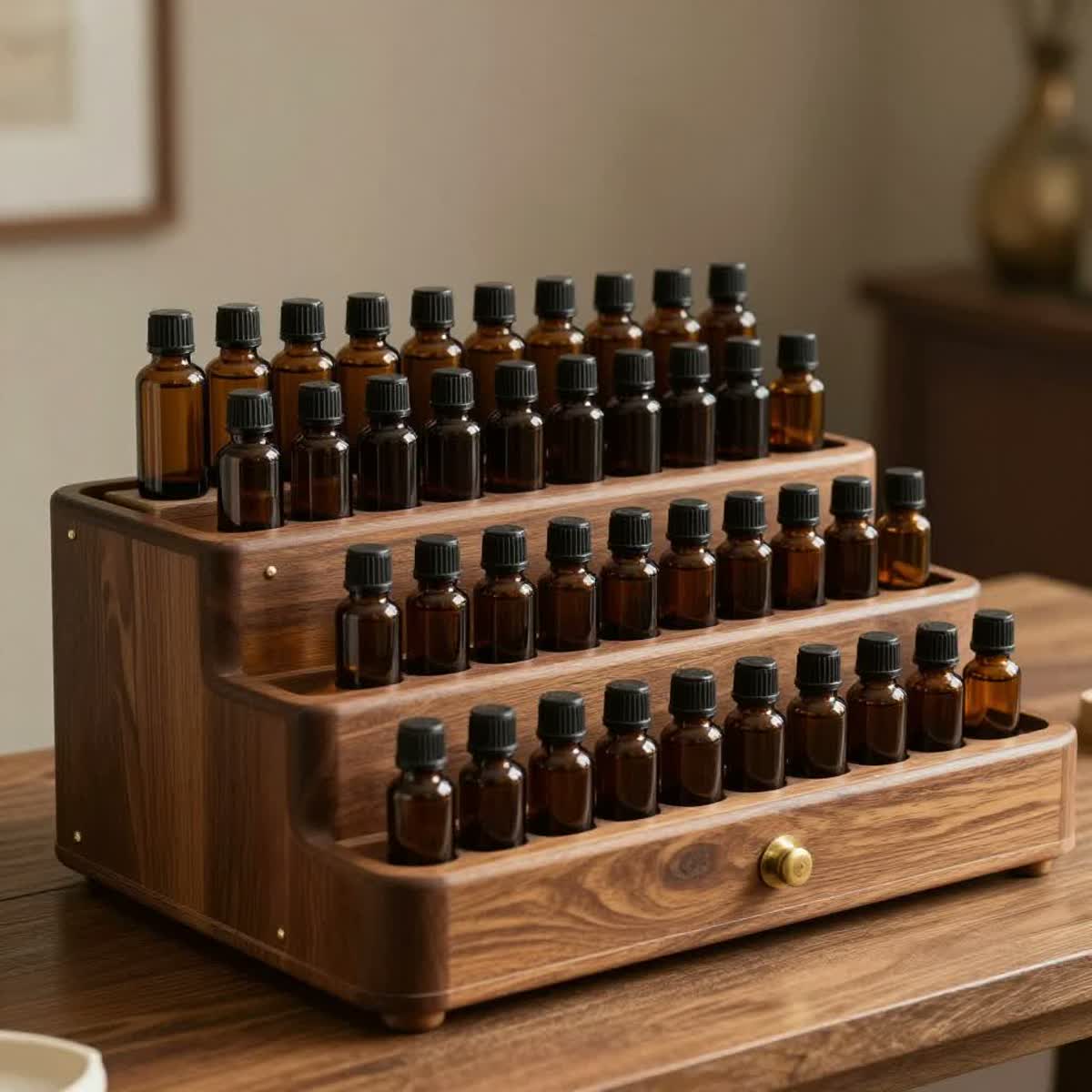
A perfumer's workspace is traditionally called an organ, a curved, tiered shelf (the shape genuinely resembles a pipe organ's console) holding hundreds of small bottles of raw materials arranged within arm's reach, organized so the perfumer can access dozens of materials quickly while actively composing, without having to walk across a room mid-thought.
A working perfumer's organ at a major fragrance house typically holds somewhere between 500 and 3,000 materials, though any single formula usually draws from a much smaller working set, the point of the organ isn't that every formula uses everything on it, but that the materials likely to be reached for together are physically close together. Junior perfumers at houses like Givaudan (Chapter 40) are expected to memorize the character of roughly 500 core materials by scent alone as a foundational requirement, well before they're trusted to formulate independently, a scale of raw memorization most other creative disciplines don't ask for.
Digital tools have started to supplement, though not replace, the physical organ, some houses now use software (Givaudan's proprietary "Carto" tool is one public example) that lets a perfumer combine materials visually and predict how a blend will smell before physically mixing it, speeding up the early exploration phase of a project. But the physical smelling and mixing stage, sample, evaluate, adjust, resample, remains, as of this writing, an irreplaceable part of the process; no software yet fully substitutes for a trained human nose making the final call.
Chapter 28, Writing a Brief
A commercial fragrance almost never starts with a perfumer deciding "I want to make something woody." It starts with a brief, a document from a brand (or a brand's marketing team) to a fragrance house, describing what the finished perfume needs to achieve commercially, not chemically.
A real brief typically specifies a target consumer and price tier, a competitive set (existing perfumes it should smell distinct from, or sit convincingly alongside, on a shelf), sometimes a rough olfactory direction ("modern chypre," "gourmand but not sweet") but rarely a precise formula, a required IFRA compliance standard, and a cost ceiling per kilo of finished juice, a genuinely tight commercial constraint that shapes which materials are even viable candidates before a single note is chosen. Multiple fragrance houses are often briefed simultaneously and compete for the same commission, submitting finished sample formulas the brand then chooses between, meaning a huge amount of perfumery's most interesting creative work is done for briefs that are ultimately rejected and never see a shelf.
This is a genuine tension worth understanding as a consumer: the brief-driven, commercially competitive model of designer perfumery (Chapter 39) is structurally very different from how a niche or independent perfumer typically works, often starting from a personal concept or memory (echoing Chapter 2's Proust effect directly) rather than a market brief, which is a real part of why niche and designer fragrances tend to feel different even when built from similar raw materials.
Chapter 29, Building the Pyramid in Practice
A perfumer doesn't build a fragrance by picking a top note, then a heart note, then a base note in sequence. They usually start from the brief (Chapter 28) or a personal concept, and build accords (Chapter 24) for each layer, testing constantly how they interact with each other, not just how each smells alone.
In practice, materials rarely stay confined to one layer. A base note like vanilla might be present in the formula from the very first minute, just masked by louder top notes until they evaporate away, what you perceive as the pyramid "unfolding" is really a mix that was always complete, just changing which parts are loud enough to notice as lighter materials fade (Chapter 3 explains why).
A finished commercial fragrance is typically the result of dozens, sometimes hundreds, of trial formulas refined over months or years, with the transitions between top, heart, and base smoothed deliberately so the scent doesn't feel like it's switching abruptly from one smell to another. A well-built pyramid should feel like one continuous story, not three unrelated chapters, and the number of discarded iterations behind any finished commercial perfume is almost always far larger than consumers assume.
Pick a real perfume you know well. Write a short critique of its pyramid as if you were reviewing a brief (Chapter 28): where does the transition between top and heart feel smooth versus abrupt? Is there a moment where it feels like three unrelated ideas rather than one continuous story? If you had to send it back for one specific revision, what would you ask the perfumer to fix, and why, citing the actual materials or volatility tiers (Chapter 18) you think are responsible, not just a vague impression. There's nothing to submit or grade here; the value is entirely in forcing yourself past "it changes over time" into a specific, defensible critique.
Chapter 30, Fixation, Layering, and Dilution
Fixation uses the physics from Chapters 3 and 18 deliberately: heavy, low-volatility materials (musks, resins, heavy woods) are added specifically to slow the evaporation of lighter materials around them, making the whole composition last longer on skin. A "fixative" isn't just any base note, it's a base note specifically chosen for its ability to anchor everything above it.
Layering (in the compositional sense, distinct from the consumer habit of wearing two perfumes together) means using several materials that play a similar role instead of just one, three different woods instead of a single cedar note, to build depth and complexity a single material can't achieve alone. It's the difference between a flat, one-note wood accord and one that feels three-dimensional.
Dilution is simpler than it sounds: the aromatic "juice" (the actual blended formula, referred to in the industry as the concentrate) is diluted in perfumer's alcohol to reach the target concentration (Chapter 37). A formula built to be sold as a 20% Eau de Parfum is roughly 20% concentrate and 80% alcohol, plus a small amount of water and often a small amount of fixative like benzyl benzoate in the diluent itself. Importantly, a perfumer often has to rebalance the actual formula slightly at different dilution levels, since materials don't all become louder or quieter at the same rate as concentration changes, part of why an EDT version of a perfume isn't always simply "the EDP but weaker," and is sometimes a genuinely rebalanced formula in its own right.
The core formula behind every dilution, working solution, or accord trial is the same weight-percentage relationship:
pure material needed = target batch weight × desired percentage
Worked example: to make 100g of a 20% Eau de Parfum concentrate solution, you need 100g × 0.20 = 20g of concentrate, topped up with 80g of perfumer's alcohol (plus the small water/fixative fraction mentioned above).
Working with a material so powerful it can't be weighed accurately at full strength, aldehydes, pyrazines, and animalic notes like civet are common cases, perfumers pre-dilute it into a working solution before it ever goes into a formula: typically 10% or 1% strength in a neutral carrier like DPG (dipropylene glycol), IPM (isopropyl myristate), or TEC (triethyl citrate). A material used at "0.05% in the final formula" is often actually a larger, weighable amount of a 1% working solution, the same math above, just applied twice.
Stability is the part of formulation a hobbyist rarely has to think about but a commercial lab spends real time on: a finished formula has to survive months on a shelf, often in direct light and fluctuating temperature, without discoloring, separating, or losing its intended balance. Materials with certain reactive functional groups, many aldehydes, some natural absolutes carrying trace unsaturated compounds, genuinely tend to oxidize or photodegrade over time, which is why some formulas include a small fraction of antioxidant (commonly BHT) purely for shelf life, with no scent contribution of its own. Solubility is the other everyday constraint: not every aromatic material dissolves cleanly in a simple alcohol-water base, and poor solubility can leave a finished perfume cloudy or separated, especially once diluted further or chilled, testing a candidate formula's clarity across realistic storage conditions, sometimes accelerated by weeks in a heated oven to simulate months of real shelf life, is a genuine part of a formula's development timeline (Chapter 32) most enthusiasts never see.
Further reading: real 1892 formulas in the Historical Formula Index use exactly this kind of parts-by-weight proportion, Deite's recipes even state the convention explicitly.
Chapter 31, Evaluation: Blotters, Skin, and GC-MS
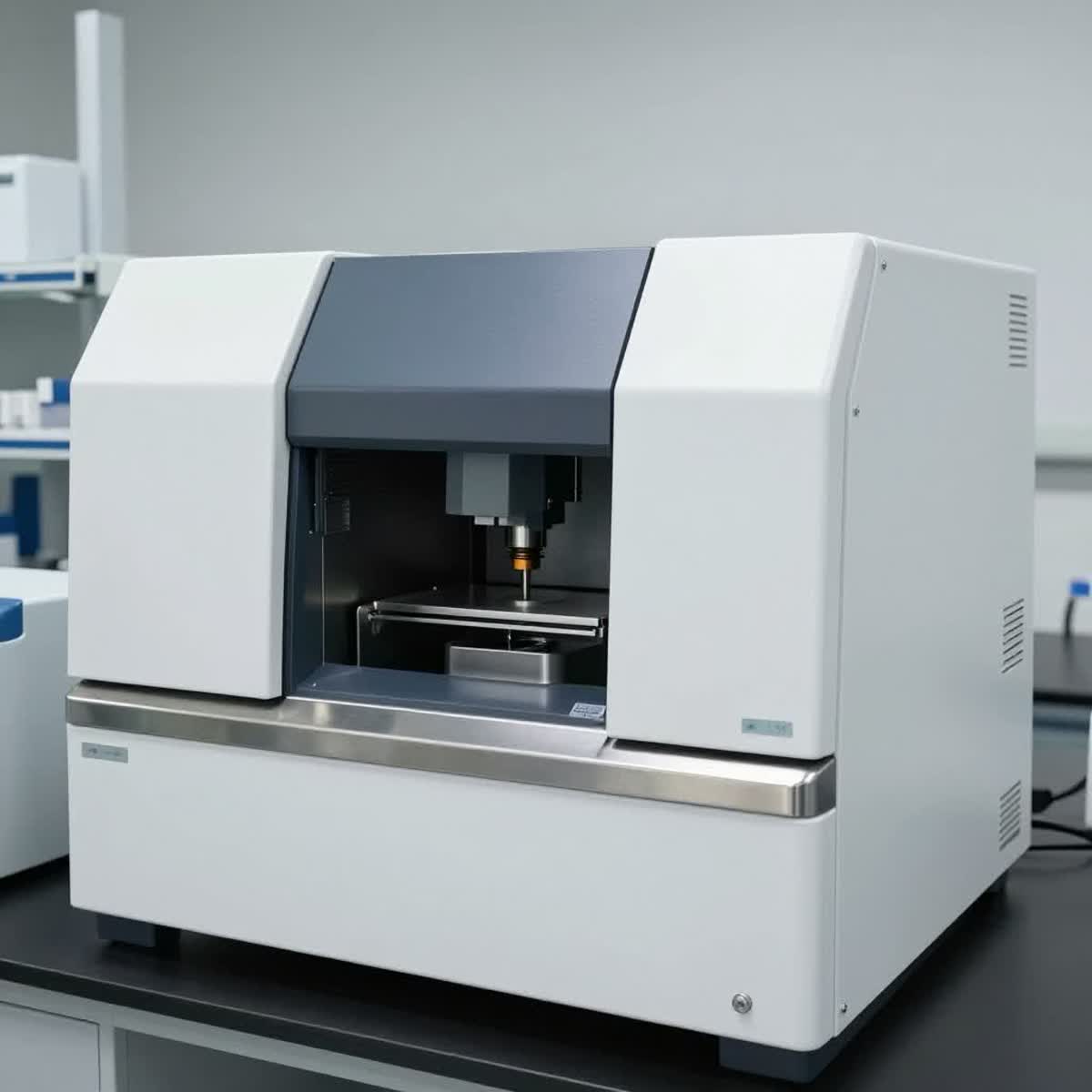
Professional evaluation runs on the same logic Chapter 38 recommends for consumers, formalized: a formula is tested on a blotter (a thin paper strip, dipped and waved to disperse solvent) for quick early-stage comparison between many candidate formulas side by side, then moved to skin testing on multiple evaluators as it progresses, precisely because skin chemistry varies (Chapter 4) and a formula that reads beautifully on one evaluator's skin needs to be checked against others before it's considered finished.
GC-MS, gas chromatography-mass spectrometry, is the standard analytical instrument in professional fragrance work, and it's worth understanding in plain terms rather than as an intimidating acronym. A sample is vaporized and passed through a long, thin column; different molecules travel through the column at different speeds based on their chemical properties, so they exit the far end separated from each other in a specific order (this is the "gas chromatography" half). Each separated molecule is then identified by the mass spectrometer, which essentially weighs and fragments it in a way that produces a specific, near-unique signature, matched against a reference database.
In practice this means a perfumer or lab can take an unknown liquid, a competitor's fragrance, an old formula with lost documentation, an unusually good natural extract, and get back a detailed list of exactly which molecules are present and in roughly what proportion. It's the technology behind "reverse-engineering" a competitor's fragrance, and also the technology behind headspace analysis (Chapter 14) that lets a perfumer analyze the scent profile of a living flower too fragile to extract.
The output, a chromatogram, is simpler to read than it looks: a graph with time along the bottom (retention time, how long each molecule took to travel the column) and signal intensity up the side, so each molecule shows up as one distinct peak. A taller peak means more of that molecule relative to the others in the same run; the peak's horizontal position is what gets matched against a reference library to identify which molecule it actually is. A finished fragrance run through GC-MS typically produces dozens to well over a hundred distinct peaks, most fragrances, even ones marketed around a single named note, are genuinely complex mixtures once you can see the full picture.
Headspace technology pairs with GC-MS to solve a different problem: rather than analyzing a liquid sample, a sealed enclosure is placed directly around a living flower (or another sample too rare or fragile to extract), and the air inside, the headspace, is drawn through an absorbent trap over several hours, which is then analyzed by GC-MS exactly as a liquid sample would be. That produces a molecular profile of a scent that was never actually captured as oil at all, which is how perfumers have built convincing reconstructions of flowers like lilac and lily of the valley that yield almost no usable essential oil through traditional extraction (Chapter 14), rebuilt synthetically, facet by facet (Chapter 25), straight from their headspace data.
Chapter 32, Concept to Shelf: How Long It Really Takes
A commercial fragrance's development timeline, from initial brief (Chapter 28) to appearing on a shelf, is typically measured in years rather than months, commonly somewhere in the range of 18 months to 3 years for a major designer or celebrity launch, and it can run considerably longer for a genuinely ambitious niche or prestige project. Consumers who assume a new fragrance was created in response to a current trend are usually wrong about the timeline; the formula was very likely finalized well before the trend it appears to be riding was even visible.
Most of that time isn't spent on the creative formulation work covered in Chapters 27-31, though that alone can take months of iteration. A large share goes to consumer testing (panels of target consumers evaluating candidate formulas, sometimes across multiple international markets since scent preference varies meaningfully by region), regulatory compliance checks against IFRA and each target market's specific cosmetic regulations, packaging and bottle design running in parallel, and production scale-up, moving from a formula that works at 100ml lab-batch scale to one that's stable and reproducible at hundreds of thousands of liters.
This long lead time is part of why "flanker" fragrances (Chapter 39) are commercially attractive to brands beyond simple risk reduction: reusing an existing, already-approved base formula and adjusting it meaningfully shortens the regulatory and testing cycle compared to starting an entirely new fragrance from zero.
What is a "fixative" specifically chosen to do?
What does GC-MS let a lab determine about an unknown fragrance sample?
Chapter 33, Building a Reference Kit on a Budget
You don't need a professional organ (Chapter 27) or a lab budget to start real olfactory training, you need a small, deliberately chosen set of reference points and a system for using them consistently. This is the same principle behind the Grasse Institute's own online course, which ships students a physical kit of about ten raw materials specifically for blind-testing exercises rather than trying to cover the whole palette at once.
A genuinely useful starter kit is smaller than most beginners expect: one clean citrus (a real bergamot or sweet orange essential oil), one classic rose material (rose absolute or even a good rose essential oil), one white floral (jasmine absolute, or a jasmine-forward finished perfume if the pure absolute isn't accessible), one dry wood (cedar or vetiver essential oil), one resin (labdanum or benzoin), one aldehyde-forward or "clean musk" finished fragrance as your synthetic reference point, and your own skin as a control. Essential oils and absolutes from reputable natural-perfumery suppliers are the most accurate reference materials, but real finished fragrances built around a single dominant material work as an accessible substitute when isolated raw materials aren't available to you.
The goal of this small kit isn't breadth, it's building seven or eight rock-solid reference points you know cold, that you can then compare every new material or perfume against. "This smells warmer than my labdanum reference but drier than my resin reference" is a genuinely more useful evaluation than a vague adjective, and it's only possible once you've built stable references to compare against, which is exactly the logic behind Chapter 34.
Once the starter seven or eight feel genuinely familiar (Chapter 34 tells you how to check), expand deliberately rather than buying everything at once, each tier should feel mostly solid before you move to the next.
| Tier | Adds |
|---|---|
| 1 (start here) | The 7-8 materials above: one citrus, one rose, one white floral, one dry wood, one resin, one clean synthetic musk, skin as control. |
| 2 (~16 total) | One aldehyde-forward material or fragrance (Chapter 11), vanilla or a vanillin-forward gourmand note, oakmoss or a chypre-style base, lavender, patchouli, one green/galbanum-forward material, one spice (black pepper or cardamom), one animalic-register synthetic (a "skin musk" or Ambroxan-forward fragrance). |
| 3 (~24-30 total) | A second material within each family already represented, specifically chosen to contrast with the first (a second citrus like grapefruit against your first bergamot, a second wood like vetiver against your first sandalwood), this tier trains within-family discrimination, the harder skill Chapter 34's Stage 2 describes. |
Sourcing and safety, honestly. Reputable natural-perfumery and soap-making suppliers (search "perfumer's alcohol" or "fragrance oil supplier" alongside your country) sell small vials at a genuinely low per-material cost, this entire 24-30 material kit typically costs less than a single bottle of niche perfume, spread over months. Buy small (2-5ml) rather than large; you're training discrimination, not stocking a lab. Never apply an undiluted essential oil or absolute directly to skin, dilute in a neutral carrier (Chapter 30's own working-solution logic) or smell from a blotter strip instead, patch-test anything new on a small skin area first, keep everything away from children and pets, and never ingest any of it. None of this needs to be expensive or risky to be genuinely useful.
| Tier | What it unlocks |
|---|---|
| Tier 1 (7-8 materials) | Chapter 34 Stage 1 (contrast pairs) and the binary ratio trial; Chapter 63 Phases 1-3 (kit assembly through first blind self-tests); the timed-smelling protocol on any single material. |
| Tier 2 (~16 materials) | The ternary accord trial (three materials across top/heart/base); Chapter 63 Phase 4; enough range to attempt a rough version of two or three of Chapter 64's worked composition exercises. |
| Tier 3 (~24-30 materials) | Chapter 34 Stage 2 (within-family discrimination) and Stage 3 (deconstruction); Chapter 63 Phases 5-7; enough breadth to attempt most of Chapter 64's exercises and Chapter 53's own-brief reflection with real materials in hand rather than purely on paper. |
Further reading: Piesse's Odophone is itself a 46-material reference set from 1891, an earlier, differently-organized version of exactly the exercise this chapter describes.
Chapter 34, The Jean Carles Method, Adapted
Jean Carles (1892–1966) worked at Roure Bertrand Fils in Grasse and, in 1946, founded and directed the Roure Perfumery School, the training method taught there and across French perfumery education today is built on a single core insight: memorizing dozens of materials in isolation is nearly impossible, but memorizing them through relationship and contrast works.
By the time Carles composed Ma Griffe for Carven in 1946, he had become anosmic, he had lost his own sense of smell. He kept working from a lifetime of memorized odor relationships, with his son Marcel smelling and reporting back on each trial. The following year he worked with Paul Vacher and Serge Heftler-Louiche on the original Miss Dior. He's often compared to Beethoven composing after losing his hearing: the method he formalized isn't really about having a good nose in the moment, it's about building a durable, structured memory of how materials relate to each other, precisely because a perfumer can't always trust the room, the day, or even their own nose to be reliable in real time.
Stage 1, Contrast. Smell two maximally different references back to back (your citrus against your resin, say). Don't try to describe either one in isolation yet, just notice what specifically separates them: sharp versus warm, fast-fading versus lingering, simple versus complex. Repeat with different pairs. This builds the vocabulary of distinction before you try to build the vocabulary of description.
In his 1961 paper "A Method of Creation in Perfumery," Carles gives an actual worked example: absolute oakmoss and ambergris 162B, tested across a five-step progression from 9:1 down to an even 5:5.
| Oakmoss : Ambergris 162B |
|---|
| 9 : 1 |
| 8 : 2 |
| 7 : 3 |
| 6 : 4 |
| 5 : 5 |
He deliberately stops at 5:5, testing further (4:6, 3:7, and so on) would just reproduce the same five accords viewed from the other material's side, telling you nothing new. Apply the same five-step progression to two references from your own Chapter 33 kit and notice where the perceived balance point actually sits; it's rarely at 5:5, because materials differ enormously in raw strength (Chapter 18), and building an intuition for that mismatch is the entire point of the drill.
Carles's own published example stops at two materials, a real, deliberate limitation of the primary source, not something this course is simplifying away. Once a binary trial feels genuinely intuitive, the natural next step (adapted here, not from Carles's own paper) is a third material, which turns the simple 9:1-to-5:5 line into a triangular space with far more possible balances than any single line could show. A full grid across three materials would run to dozens of combinations, more than anyone needs for the drill to work. Four representative points, each summing to 10 parts, are enough to feel the shape of that triangle:
| Trial | A : B : C |
|---|---|
| Balanced | 4 : 3 : 3 |
| A leads | 6 : 2 : 2 |
| B leads | 2 : 6 : 2 |
| C leads | 2 : 2 : 6 |
Pick three references from your Chapter 33 kit, ideally one from each of top, heart, and base (Chapter 3) so the trial also tests a real vertical accord (Chapter 25), not just three materials at the same volatility. The "Balanced" trial rarely reads as the most pleasant or most interesting one, a genuinely useful accord is usually built around one material clearly leading with the other two in supporting roles, the same lesson the binary trial teaches, just harder to see with only two materials to compare.
Stage 2, Family tables. Carles arranged 60 materials in a table, families in columns and individual materials within each family in rows, so a student would first compare across families (floral column against woody column), then drill down within one family (rose against jasmine against tuberose, all in the floral column). Build your own miniature version: pick two families from your Chapter 33 kit, and spend a session comparing only within each, noting what specifically separates rose from jasmine, or cedar from vetiver, now that you're not also managing the bigger cross-family contrast at the same time.
Stage 3, Deconstruction and reconstruction. Carles's actual final exam: give the student a famous finished perfume and have them identify it, by nose alone, as a specific combination and rough ratio of known materials, the ultimate test that synthesizes everything. You don't need a lab to attempt an adapted version: pick a perfume you know well, and try to name which of the six landmark accords from Chapter 26 it's built closest to, and which two or three materials from your own reference kit you'd reach for first if you had to approximate it. You won't get it chemically exact without professional training, but the exercise of trying, honestly, is what actually builds a trained nose over time, and it's the same exercise real perfumery students are still given today.
One genuinely useful thing Carles's own paper gets right that a lot of secondary summaries flatten into oversimplification: he explicitly refused to hand students a fixed clock-time rule for what counts as top, heart, or base ("24 hours means base," say). He records the exact date and time each material starts losing its main character on a strip, but insists the resulting classification stays personal to each apprentice's own testing conditions rather than a universal number, volatility (Chapter 3, 18) is the real variable; hours are just one imperfect way of measuring it.
Two practical habits make any of this actually workable at a home desk. First, equalize odor value before you compare: never trial a powerful synthetic against a subtle natural at full strength, since the powerful material will simply drown the other, dilute both to a standardized working strength first (Chapter 30's dilution math), so what you're comparing is genuine character, not raw intensity. Second, re-check the same strip over time rather than judging once and moving on, a quick sniff at the moment of application, then again after an hour, then again the next day, will show you top, heart, and base actually taking turns being the loudest thing on the strip, which is a far more convincing way to internalize Chapter 3's evaporation curve than reading about it ever will be.
For any new material or perfume you're seriously training on, check it at five points and write one line each time, don't rely on memory across the gaps:
| Checkpoint | What you're listening for |
|---|---|
| Fresh (0 min) | First impression, full strength, often the most misleading checkpoint on its own. |
| 15 min | Has the sharpest top material already faded? What's replacing it? |
| 1 hour | The heart should be dominant now, does it match what the label or your expectation claimed? |
| 4 hours | What's actually left is the real base, often a much shorter list than the marketing copy implied. |
| Next day | On skin (not a strip): is anything still faintly there? This is the true fixative test. |
A one-line note at each checkpoint, even just "sharper than expected, citrus gone by 15min, dry woody base by 4hr", beats a single paragraph written from memory the next day. Chapter 35's scent journal is exactly this log, formalized and made a habit.
Further reading: Carles's own 1961 paper, "A Method of Creation in Perfumery", this entire chapter is adapted from it, so it's worth reading the primary source directly.
Chapter 35, Keeping a Scent Journal
Research into how olfactory expertise actually develops (studies following ISIPCA students through their 1.5-year program are a good real-world data point here) consistently finds the same thing: training doesn't just sharpen your nose, it measurably improves your language for describing what you smell, and that improved language is itself part of what makes the trained perception more precise and more durable in memory, vague perception and vague vocabulary reinforce each other, and precise vocabulary and precise perception do too.
A useful journal entry doesn't need to be long, but it should force you past "smells good." For each perfume you test seriously, note: which family or families it leans toward (Chapters 22-23), which of the sensory-vocabulary terms apply (green, powdery, animalic, aldehydic, gourmand, aromatic, balsamic, or whichever of the six landmark accords from Chapter 26 it most resembles), how it actually changed on your skin over several hours rather than just your first impression, and, critically, what it reminded you of, since the Proust effect (Chapter 2) means your most useful and most personal reference points will often be memories, not other perfumes.
Do this consistently for even twenty or thirty perfumes and you'll notice your own vocabulary sharpening in exactly the way the research describes, you'll stop reaching for "nice" and start reaching for specific, comparative, useful language, the same shift professional training is measured by.
Copy this table (or recreate it on paper) for each perfume or material, the same seven fields every time is what makes entries comparable to each other later, which is the entire point. The five checkpoint columns are exactly Chapter 34's timed-smelling protocol, not a separate system.
| Field | What goes here |
|---|---|
| Date & material/perfume | What you're testing and when. |
| Fresh (0 min) | First impression, one or two words. |
| 15 min | What faded, what's replacing it. |
| 1 hour | The heart, does it match expectation? |
| 4 hours | The real base, often shorter than the box claims. |
| Next day (on skin) | Anything left at all? The true fixative test. |
| Family / accord | Chapters 22-23 family, or closest of the six landmark accords (Chapter 26). |
| Reminds me of / vs. kit reference | A memory (Chapter 2's Proust effect) or a direct comparison to a Chapter 33 kit material, whichever is more specific. |
Chapter 36, The Final Exam
Real perfumery students, at the end of Jean Carles-style training, are handed an unfamiliar finished perfume and asked to identify, by nose alone, what it's built from and in roughly what proportion. Here's an adapted version you can genuinely attempt with what this course has given you.
Pick a perfume, ideally one you don't already know the published notes for. Wear it, or test it seriously on a blotter and skin (Chapter 38), across several hours. Then work through these questions in order: Which of Edwards' four primary families, or the seven Grasse genealogies (Chapter 21), does it sit in? Which of the six landmark accords (Chapter 26) does its structure most resemble, even loosely? What's genuinely happening in the opening versus the dry-down, and can you attribute that shift to volatility (Chapters 3, 18) rather than just describing it as "it changed"? Which sensory-vocabulary terms (Chapter 8's original list, or the deeper functional-group language from Chapter 16) actually fit, specifically, not "nice," but green, or aldehydic, or a named lactone-driven creaminess?
Then look up the real notes and family classification on this site's own Perfumes pages, and compare your reasoning against what's documented. You will not match a trained perfumer's precision on your first attempt, and that's not the point, the point, exactly as it is for a real perfumery student, is that going through this analytical process honestly, repeatedly, is what actually builds the trained nose this entire course has been working toward.
Who founded and directed the Roure Perfumery School in 1946, and later composed while anosmic?
Chapter 37, Concentration Levels and Shopping Literacy
Every perfume label carries a concentration term, Parfum, Eau de Parfum, Eau de Toilette, Eau de Cologne, and most shoppers treat these as a quality ranking. They're actually a rough measure of how much aromatic concentrate is dissolved in the alcohol-and-water base (Chapter 30), which affects strength and longevity, not necessarily how "good" the formula is.
Rough industry conventions, from strongest to lightest: Parfum / Extrait de Parfum (roughly 15-40% aromatic compounds), Eau de Parfum (EDP) (roughly 10-20%), Eau de Toilette (EDT) (roughly 5-15%), and Eau de Cologne (EDC) (roughly 2-5%, light and often reformulated for a fresh, quick-hit effect). These percentage ranges are industry convention, not enforced legal standards, brands don't have to publish their actual concentration, and ranges overlap in practice.
One more common mix-up: the same perfume name often exists in totally different concentration versions, and sometimes even genuinely different formulas (Chapter 30's point about rebalancing at different dilutions), under names like "Extreme" or "Intense", treat these as related but distinct products, not just a stronger dose of the same liquid.
"Eau de Parfum is always better quality than Eau de Toilette." Reality: concentration tells you strength and rough longevity, not quality, these percentage ranges are industry convention, not enforced legal standards, and a well-built EDT can be a more accomplished formula than a poorly balanced EDP.
"An EDT is just an EDP with water added." Reality: a perfumer often has to rebalance the actual formula at different dilution levels, since materials don't all get louder or quieter at the same rate as concentration changes (Chapter 30), the EDT is sometimes a genuinely different, deliberately rebalanced formula, not a diluted copy.
Chapter 38, How to Actually Test and Evaluate a Perfume
Most people judge a perfume in the first ten seconds off a paper strip in a store, close to the worst possible way to evaluate one, since you're smelling almost pure top notes on a surface that doesn't behave like skin at all (Chapter 4).
Test on skin, not just paper, your skin's oils, pH, and warmth all change how a fragrance develops. Give it real time, since a perfume moves through top, heart, and base over hours (Chapter 3), judging it in the first five minutes only tells you about the top notes, often the least representative part of the whole scent; a proper test means wearing it several hours, ideally a full day. Don't test too many at once, olfactory adaptation (Chapter 4) means your nose genuinely stops distinguishing scents accurately after three or four in a row.
Build a vocabulary beyond "smells good" or "smells bad", the family (Chapter 21), the sensory terms (green, powdery, animalic, aldehydic, gourmand, aromatic, balsamic), and the notes that stand out to you turn a vague impression into something you can actually compare across perfumes, search for, and shop with. Consider keeping the scent journal from Chapter 35 as your default practice, it's the single habit most correlated with actually developing a trained nose over time, more than any individual fact in this course.
Chapter 39, Niche, Designer, Celebrity, and Flankers
Perfumes roughly split into three commercial tiers, and knowing them explains a lot about pricing and marketing you'll see while shopping. Niche houses (Chapter 13) release in smaller batches, often credit the perfumer by name, spend little on advertising, and charge accordingly more per bottle. Designer fragrances are backed by a fashion house, produced at large scale, distributed everywhere, and heavily marketed, the perfumer is rarely mentioned, and the formula is typically developed against a commercial brief (Chapter 28) rather than a personal concept. Celebrity/mass-market fragrances lean almost entirely on a famous name for sales, priced for drugstore accessibility, and usually developed fast to catch a moment of relevance.
Flankers are a specific business tactic worth knowing on its own: instead of launching a completely new fragrance, a brand releases a variation on an already-successful one, adding a word like "Intense," "Elixir," or "Extreme" to the original name. It's a lower-risk way to keep a proven franchise generating new sales without betting on an entirely new concept, and it's genuinely faster to bring to market (Chapter 32) since it can often reuse an already-approved base formula. That's why you'll often find five or six related versions of one famous perfume name in this catalog rather than just one.
Chapter 40, Becoming a Perfumer: Real Training Paths
If this course has genuinely hooked you, several real institutions offer the training this article draws on. ISIPCA, founded in 1970 in Versailles, is France's leading perfumery school, offering programs from Bac to Bac+6 level integrating olfactory training with chemistry, formulation, IFRA regulation, and business, and its students get access to the Osmotheque, a conservatory holding over 4,000 historic fragrances, including some 800 reconstructions of discontinued classics no longer available anywhere else in the world.
The Grasse Institute of Perfumery (Chapter 8) runs an 18-month flagship program, the International Technical Degree in Fragrance Creation and Sensory Evaluation, with 1,200 total training hours, roughly half taught by working perfumers and technical experts, half spent in supervised practical work and site visits, capped at just 12 students per cohort. It also offers a genuinely accessible online course (the same one this course's Chapter 33 kit design draws from) as an entry point without relocating to France.
The largest fragrance houses run their own in-house schools rather than hiring only from outside programs. Givaudan's Perfumery School runs a four-year curriculum starting with memorizing around 500 raw materials, followed by field visits (Provence for lavender, Morocco for mimosa), lab work building accords, international internships, and mentorship from senior perfumers. Cinquieme Sens, founded in Paris in 1976, offers shorter, more flexible training aimed at both working professionals and passionate individuals, covering formulation across the olfactory families alongside perfume reproduction and creativity development.
The honest throughline across every real program here: there is no shortcut around volume of exposure. Whether it's Givaudan's 500 memorized materials, ISIPCA's multi-year integration of chemistry and creativity, or Carles's own decades-old contrast method still being taught today, becoming an actual professional "nose" is measured in years of structured, repeated exposure, this course can give you the real vocabulary and mental models institute students start with, but it cannot substitute for that time.
Chapter 41, Where to Go From Here
You now have a real, institute-modeled foundation: the actual neuroscience of smell and why it hits memory and emotion so directly (Part I), six thousand years of history told through the specific inventions and decisions that actually shaped it rather than vague eras (Part II), the real chemistry behind raw materials natural and synthetic (Part III), more than one professional classification system and how accords are actually built (Part IV), the genuine mechanics of how a fragrance gets made commercially (Part V), a real, adapted version of the training method professional perfumers still use (Part VI), and the shopping, business, and career context around the whole industry (Part VII).
The most useful next step is simply to start using it: browse Families and Materials to find the language for what you already like, use Search to filter by note and family, keep the scent journal from Chapter 35 running, and revisit the final-exam exercise in Chapter 36 every so often with a new perfume, you'll notice your own answers getting sharper each time. That habit alone, more than any single fact in this course, is what actually builds a trained nose over time.
Which concentration tier typically has the highest proportion of aromatic compounds relative to alcohol?
A "flanker" in perfume marketing refers to what?
Chapter 42, Functional and Technical Fragrance
Everything this course has covered so far, the pyramid, accords, evaluation on blotters and skin, assumes the end product is a fine fragrance: a perfume, eau de parfum, or cologne, worn essentially alone. But most professional perfumery work, and most of the industry's actual revenue, is functional: fragrance formulated to go inside a shampoo, a laundry detergent, a body wash, a candle, or a household cleaner, where it has to survive a completely different set of physical and chemical demands than a fine-fragrance concentrate ever faces. Real training programs like the Grasse Institute of Perfumery explicitly teach both tracks side by side, not as an afterthought to fine fragrance but as an equally serious discipline with its own techniques.
The core challenge is that a functional base actively fights the fragrance far more than perfumer's alcohol does. A shampoo or shower gel base is a surfactant system, the same class of molecule that lifts oil and dirt off skin and hair also strips and interferes with fragrance oils, so materials have to be chosen partly for how well they survive suspension in a surfactant base without separating, clouding the product, or fading prematurely. A laundry detergent fragrance faces an even harder problem: it has to smell right in the concentrated liquid or powder, survive a hot wash cycle alongside aggressive cleaning chemistry, and still be perceptible on dry fabric days later, which is why detergent perfumery leans heavily on encapsulation, microscopic polymer shells that trap fragrance oil and only release it under mechanical stress like the friction of putting on a shirt, giving a "scent burst" long after the wash itself.
Candles present their own distinct problem: a fragrance oil has to survive being heated well past 60°C during the pour without degrading, then perform accurately both cold (cold throw, how it smells unlit on a shelf) and hot (hot throw, how it smells and how strongly it fills a room once burning), two genuinely different tests a fine-fragrance evaluator never has to run. A material that reads beautifully on a blotter (Chapter 31) can perform completely differently, or barely register at all, once suspended in wax and subjected to a flame's heat.
This is also where maximization becomes a real formulation goal rather than a stylistic choice: because functional products are typically used at far lower fragrance-oil percentages than fine fragrance (often 0.5-3%, versus 15-30% in an eau de parfum), and because the base itself is actively working against the fragrance, functional perfumers often lean on high-impact, low-cost synthetic materials chosen specifically for how loud and long-lasting they are per gram, rather than the layered subtlety a fine-fragrance evaluator would reward. It's a genuinely different craft with its own expertise, not a simplified version of fine-fragrance work, and it's where the large majority of professional perfumers, including many Grasse Institute and ISIPCA graduates, actually spend their careers.
Chapter 43, Regulation Beyond IFRA
IFRA (Chapter 19) is the industry's own voluntary safety standard, and essentially every legitimate fragrance house follows it, but IFRA compliance alone doesn't automatically satisfy every government's actual law, and a formula legally sellable in one market can require real changes before it's legally sellable in another.
In the European Union, the relevant law is REACH (Registration, Evaluation, Authorisation and Restriction of Chemicals), a much broader chemical-safety regulation covering every chemical substance sold in the EU, fragrance materials included. REACH can restrict or require registration of a chemical based on environmental persistence or toxicity data that has nothing to do with IFRA's own sensitization-focused review, meaning a material can be fully IFRA-compliant and still face separate REACH restriction, or vice versa. The EU's Cosmetic Products Regulation adds a further layer specific to fragrance: the mandatory allergen-labeling list referenced in Chapter 19, which is periodically expanded, a recent amendment roughly tripled the list of individually named allergens requiring on-pack disclosure, a real compliance burden that pushed some brands to quietly reformulate around a shorter list of disclosed materials rather than update packaging repeatedly.
The United States regulates cosmetic fragrance very differently: the FDA does not pre-approve individual fragrance ingredients or require the detailed allergen labeling the EU mandates, instead allowing "fragrance" to appear on an ingredient list as a single umbrella term that protects the formula as a trade secret, a genuinely different philosophy from the EU's disclosure-first approach, and a real reason the same perfume's ingredient panel looks meaningfully different depending on which market's bottle you're holding. Other major markets add their own layers again: China's cosmetics regulator has historically required more extensive pre-market safety testing and registration than either the US or EU for products sold domestically, which is part of why a global launch's timeline (Chapter 32) sometimes has a market-specific compliance step that adds months for one region without affecting the others.
None of this changes the actual scent a perfumer is trying to create, but it genuinely shapes which raw materials are even available to reach for in the first place. A formula built for global distribution is, in a real sense, being formulated against a moving target of several overlapping and not-always-consistent regulatory frameworks at once, IFRA included but not IFRA alone.
Further reading: the current IFRA Standards Library, also referenced in Chapter 19, publishes each Standard's specific safety rationale, a good place to see how the sensitization-focused review this chapter contrasts with REACH actually works in practice.
Last reviewed: August 2026, regulatory content changes as REACH and national cosmetic law evolve; treat the specifics here as a snapshot, not a live feed.
Why does detergent perfumery often rely on encapsulation?
What does REACH regulate that IFRA does not necessarily cover?
Chapter 44, Citrus Materials, Family by Family
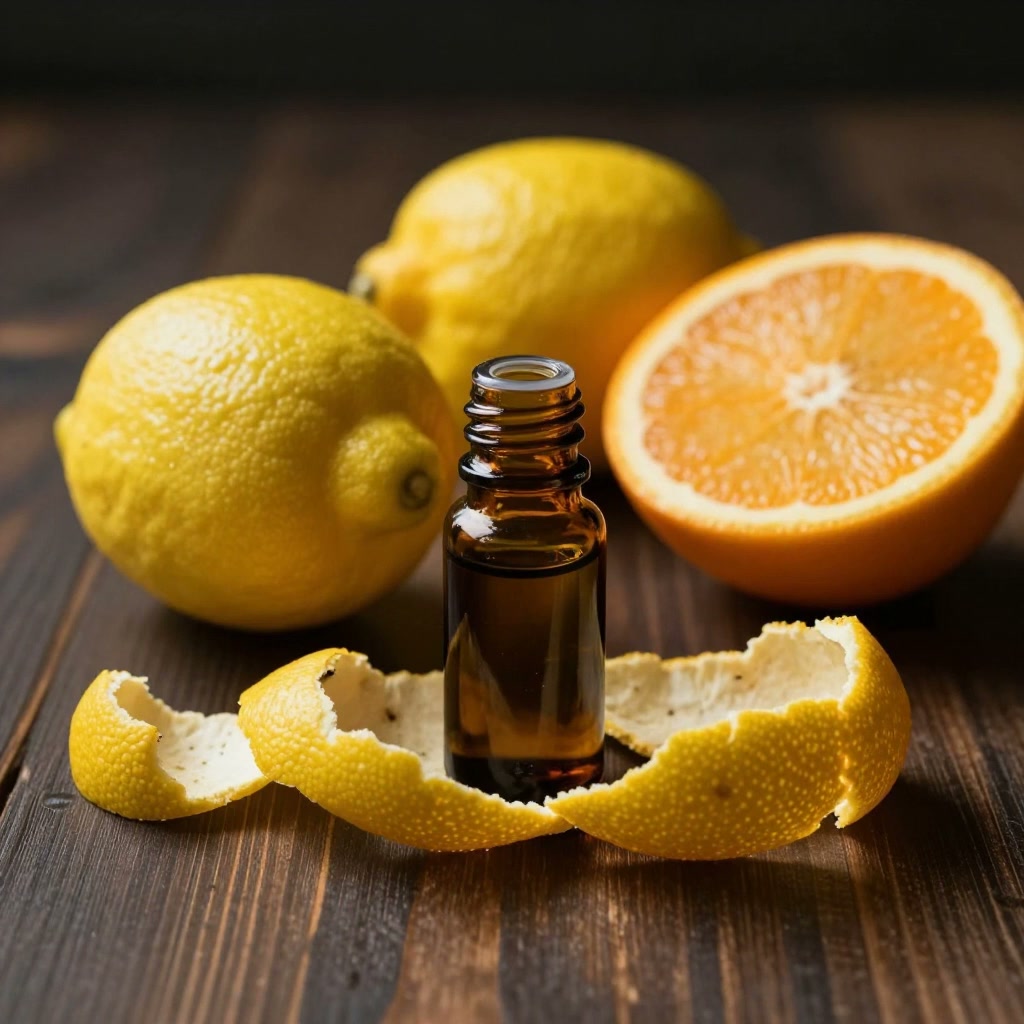
Chapter 15 introduced natural materials as a survey; this Part goes back through the major families one at a time, at the depth a real materials-knowledge module actually requires. Citrus is the right place to start, since it's almost always the first thing a beginner's nose meets and the fastest to fade (Chapter 3, 18), nearly every citrus material used in perfumery is cold-pressed (expressed) directly from the peel rather than distilled, which preserves a brighter, truer top note than heat-driven steam distillation would.
Bergamot, grown almost exclusively around Reggio Calabria in southern Italy, is the backbone of the entire cologne and chypre traditions (Chapter 23) and the actual flavoring in Earl Grey tea. It contains bergapten, a furocoumarin that's genuinely phototoxic in sunlight, which is why most modern bergamot in leave-on products is FCF (furocoumarin-free), a distilled fraction with the phototoxic compounds removed, at some real cost to the oil's full complexity. Lemon reads sharper and more astringent; sweet orange and mandarin are rounder and sweeter, with mandarin specifically prized for a soft, almost floral edge citrus rarely has; grapefruit carries a slightly bitter, sulfurous facet (from a trace compound so potent it's detectable at parts-per-trillion) that reads as unmistakably "grapefruit" rather than generic citrus; lime splits into cold-pressed (bright, true) and distilled (greener, more bitter, from heat-driven changes to the oil) versions that smell meaningfully different from each other.
Because citrus fades so fast on its own, it almost never appears alone in a finished formula, it's nearly always faceted (Chapter 25) alongside longer-lasting synthetic citrus notes (like citral or the various terpene-based aroma chemicals from Chapter 17) that extend the impression of freshness well past the point the real oil has evaporated off the skin, and vertically paired with heavier base materials chosen specifically to give the fleeting opening something to eventually hand off to.
Chapter 45, White Florals, Family by Family
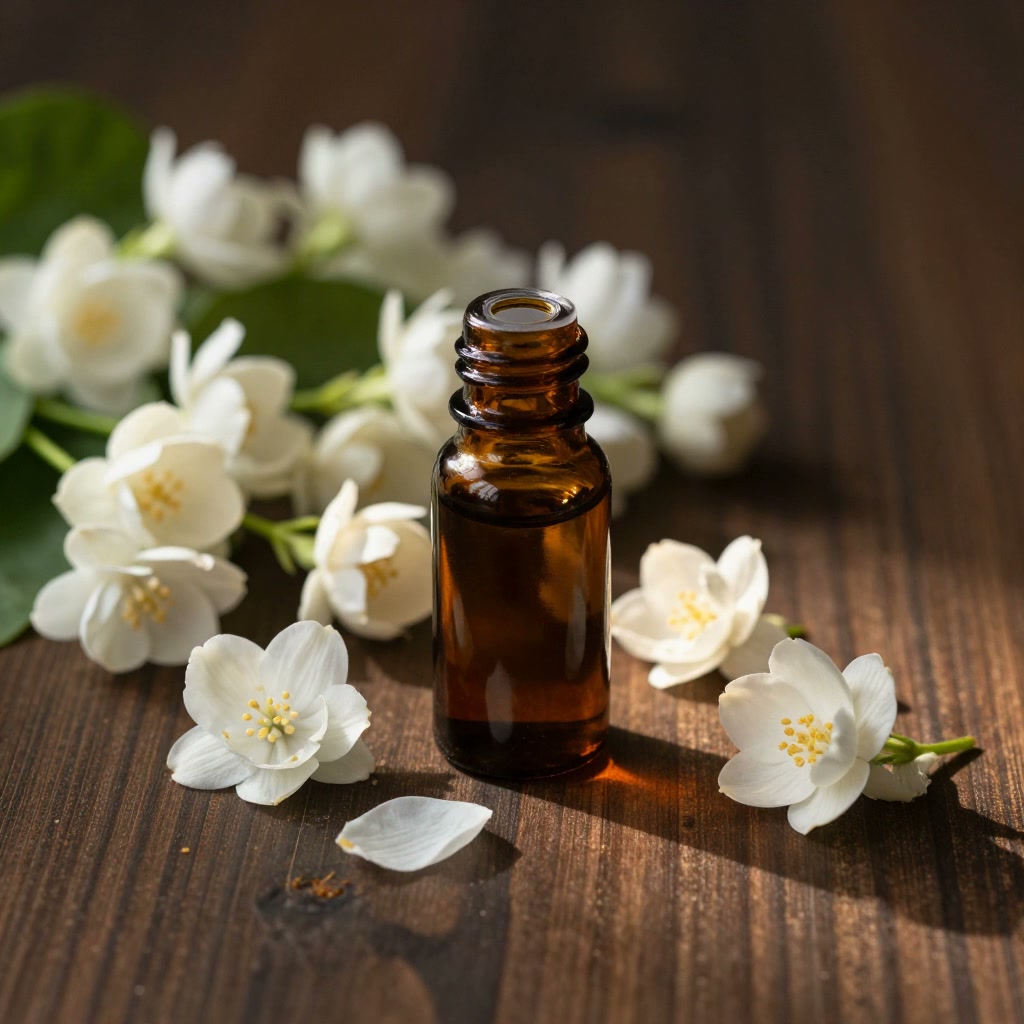
Jasmine absolute is perfumery's single most-used floral raw material, and its most instructive lesson is about concentration itself: it contains real indole, a compound that smells genuinely fecal and unpleasant at high concentration, but reads as warm, sensual, and unmistakably "jasmine" at the trace levels present in the real flower and absolute, the same compound doing opposite emotional work purely as a function of dose. Grandiflorum jasmine (grown heavily in Egypt and India today) is rounder and more classically floral; sambac jasmine (native to South and Southeast Asia) is sharper and more overtly fruity-green.
Tuberose absolute is thick, waxy, and buttery-sweet, historically extracted by enfleurage (Chapter 14) before solvent extraction became standard, and remains one of the most expensive florals to produce since the flowers keep releasing scent after cutting and must be processed continuously. Orange blossom is a genuine two-for-one case: the same bitter orange tree's flowers, distilled, give neroli (green, slightly bitter, sharper), while solvent-extracted, they give orange blossom absolute (richer, honeyed, less green), two materially different smells from the identical flower, purely a function of extraction method (Chapter 14). Gardenia is the opposite case: it yields so little usable oil through any traditional method that almost every "gardenia" note in commercial perfumery is a synthetic reconstruction built from headspace data (Chapter 31), not a real extract at all.
Ylang-ylang is fractionally distilled into graded cuts, Extra, then I, II, and III, pulled off at different points during a single long distillation, with Extra capturing the lightest, most delicate top fractions and grade III the heaviest, most animalic-leaning tail end; a perfumer chooses the grade deliberately rather than treating "ylang-ylang" as one uniform material, the same logic Chapter 20's sourcing pressure discussion and Chapter 43's regulatory chapter both touch on for this specific oil.
Chapter 46, Rose and Violet, in Depth
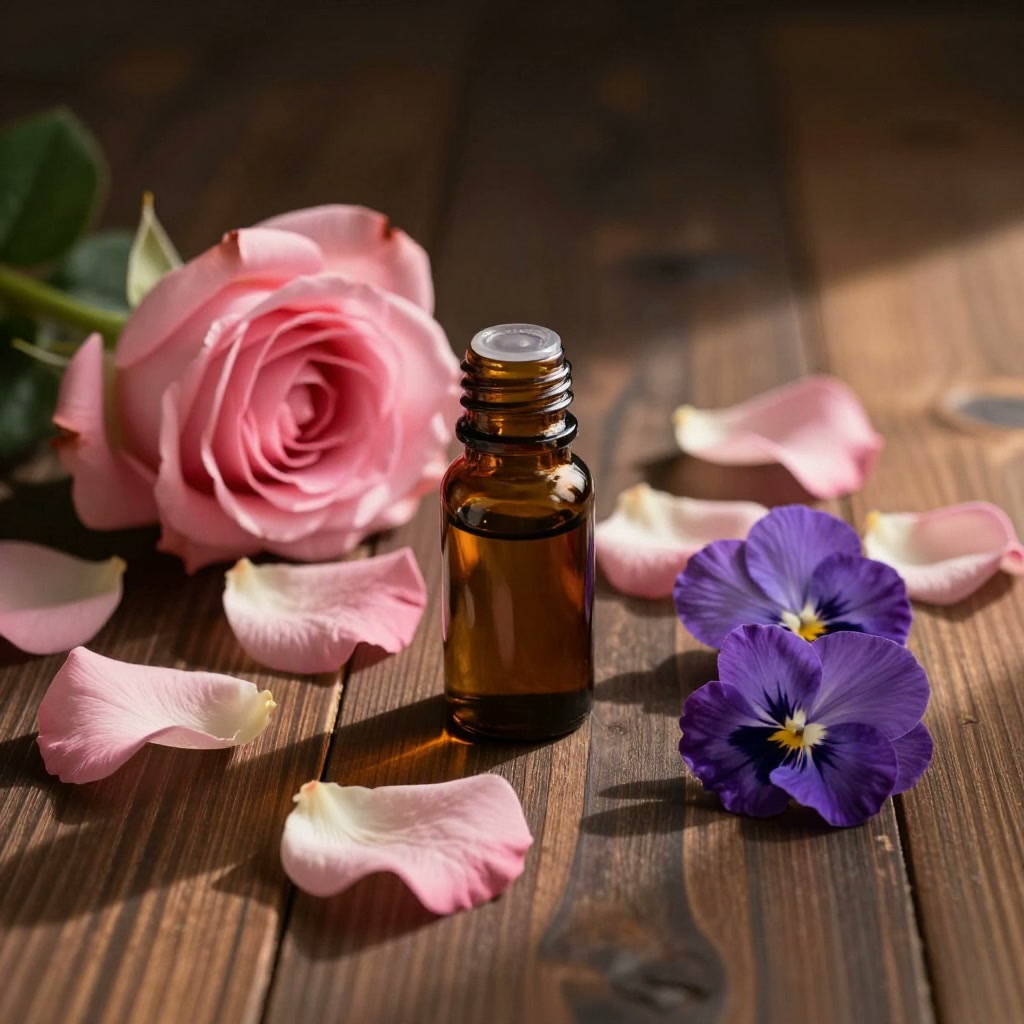
Rose splits into two materially different products from two different rose species. Rose otto (steam-distilled from Rosa damascena, chiefly in Bulgaria's Rose Valley and Turkey) is lighter, sharper, and includes real rose-oxide freshness that solvent extraction can't capture. Rose absolute (solvent-extracted, chiefly from Rosa centifolia grown around Grasse) is deeper, jammier, and closer to how a real rose actually smells in the garden, since solvent extraction pulls heavier, less volatile compounds that steam distillation leaves behind. Rose water, the aromatic byproduct condensate of the otto distillation, is itself a real, separately used material, not a waste product.
Rose's chemistry is the clearest real-world example of faceting (Chapter 25) in the entire natural palette: citronellol and geraniol carry the green-rosy backbone, phenylethyl alcohol carries a honeyed-waxy sweetness, and the damascones (only present in trace amounts, yet disproportionately responsible for rose's distinctive jammy-fruity character) tie the whole accord together, which is exactly why a synthetic rose reconstruction built from these same four or five materials can smell more convincingly "rose" than a real rose oil diluted too far to register.
Violet leaf absolute, green, cucumber-like, slightly metallic, is a real, commercially available material extracted from the leaves. The actual violet flower is a different story entirely: it yields so little oil that direct extraction is essentially commercially nonexistent, so nearly every "violet" note in perfumery is built from ionones, the synthetic materials whose accidental 1893 discovery Chapter 9 already covers, meaning violet is arguably the family where the synthetic replacement is more commercially present in finished perfumes than the real flower has ever been.
Chapter 47, Woods, Family by Family
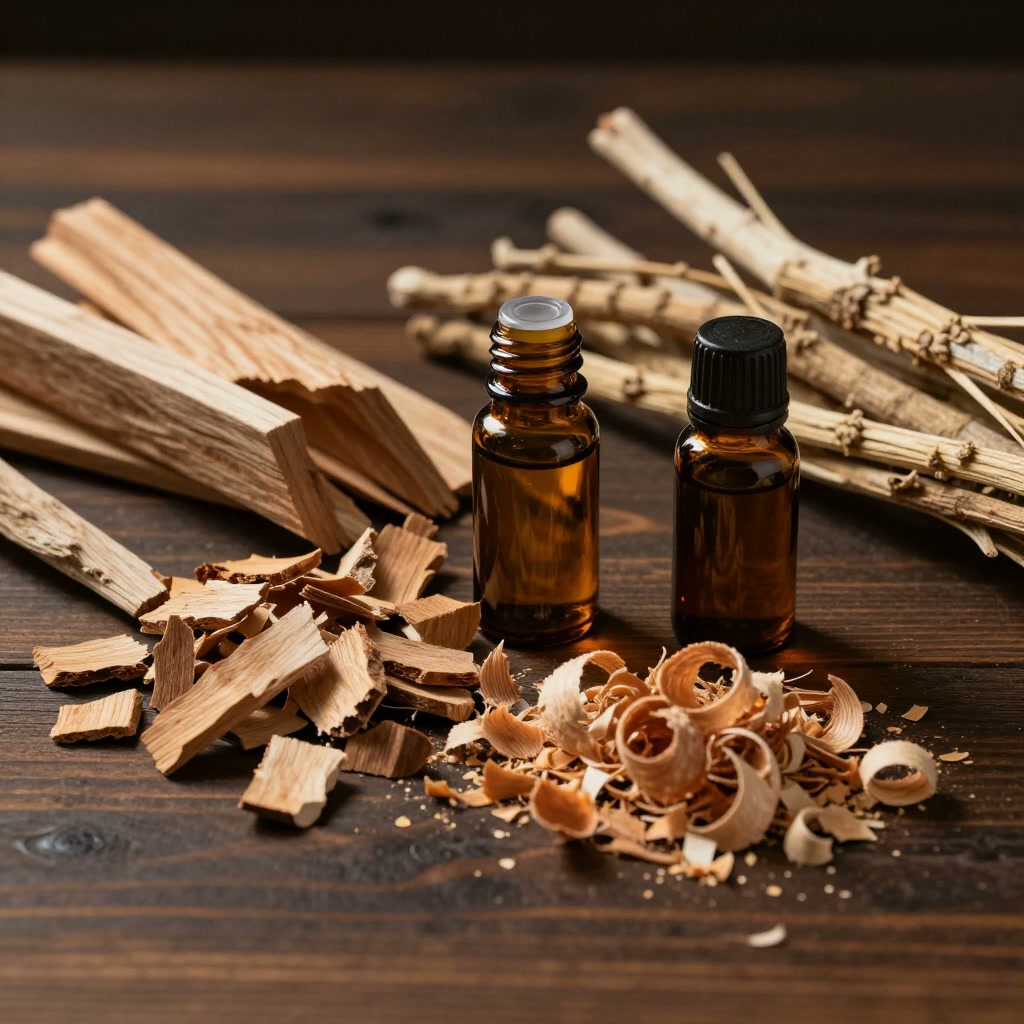
Sandalwood splits along the sourcing pressure Chapter 20 describes: Mysore sandalwood (India) is the historic gold standard, creamy and long-lasting, but export-restricted after decades of overharvesting; Australian sandalwood (a related but distinct species) has become the dominant legal source, slightly drier and less rich than Mysore but genuinely renewable through plantation cultivation. Cedarwood splits by origin rather than sustainability: Virginia cedarwood is dry, sharp, and pencil-shaving-like (it's literally the wood used in pencil manufacturing); Atlas cedarwood, from Morocco, is softer and slightly sweeter.
Vetiver is extracted from the roots rather than any above-ground part of the plant, distilled after the roots are dug up, washed, and dried, giving it a deep, earthy, almost smoky character unlike any other wood material. Haitian, Javanese, and Bourbon (Réunion Island) vetiver are the three major origins, each with a recognizably different balance of earthy-dry versus smoky-smoky character, the kind of origin-specific variation a trained nose learns to place the way a wine taster places terroir.
Oud (agarwood) is arguably perfumery's single rarest natural material: it only forms when an Aquilaria tree is wounded or infected by a specific mold, triggering the tree to produce a dark, fragrant resin in self-defense, a tree has to be found already infected in the wild (cultivation of the infection itself is a recent and still-imperfect science), making real agarwood oil extraordinarily expensive and most commercial "oud" notes synthetic reconstructions built to approximate its leathery, animalic, woody-sweet complexity. Patchouli is the opposite story: cheap, abundant, and, unusually for a natural material, actually improves with age, since the dried leaves are traditionally aged or even lightly fermented before distillation to soften a harsher green top note into the dark, earthy, chocolatey character patchouli is known for today.
Chapter 48, Resins and Balsams, Family by Family
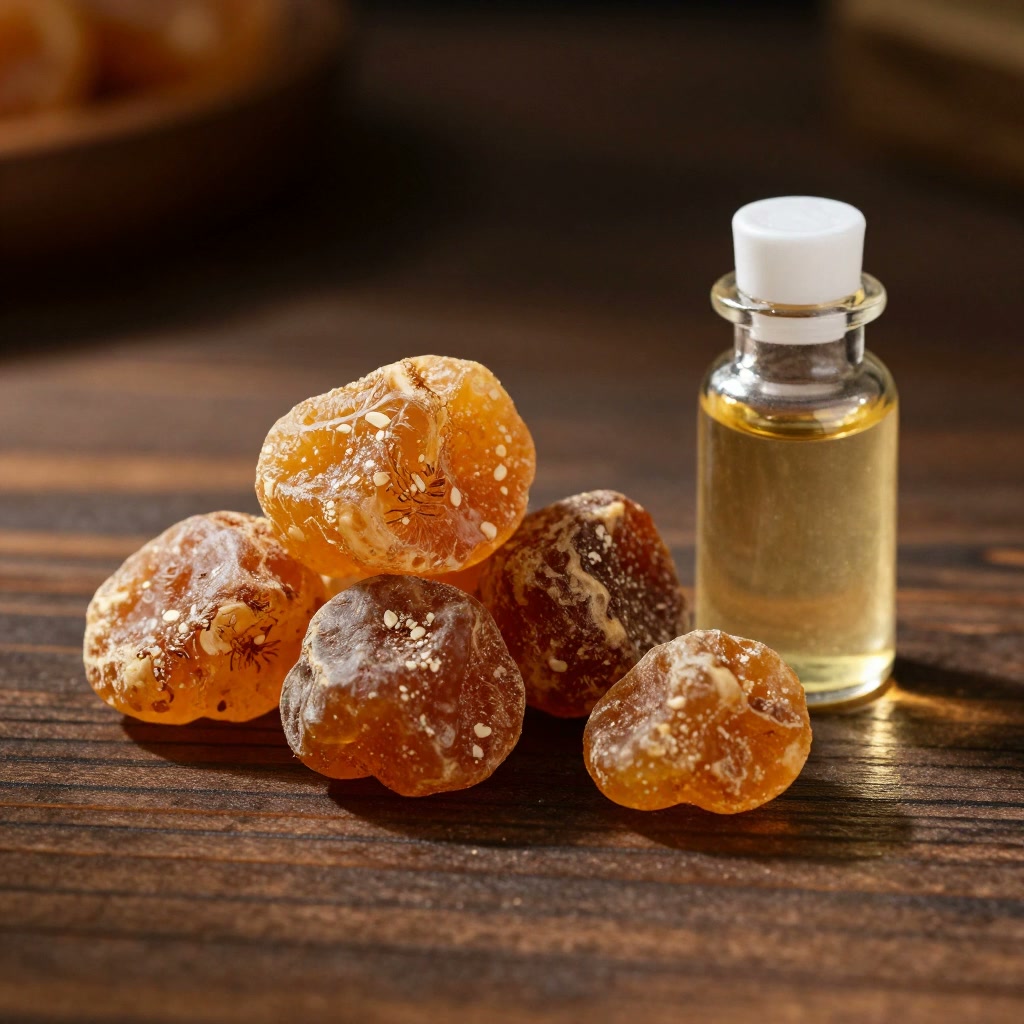
Frankincense (olibanum) and myrrh are both tree resins tapped from Boswellia and Commiphora species respectively, chiefly across Somalia, Oman, and Yemen, the same two materials burned as incense in Chapter 5's earliest documented perfumery. Frankincense is bright, resinous, and slightly citrusy-green; myrrh is darker, more bitter, and carries a distinct medicinal-balsamic edge that made it as valuable as gold in the ancient trade routes this course's history chapters cover.
Benzoin, a resin from Styrax trees, despite the confusing overlap in naming with the separate material styrax itself, splits into Siam benzoin (smoother, more vanilla-like) and Sumatra benzoin (drier, slightly more cinnamon-tinged), both used constantly as a warm, sweet base note and fixative (Chapter 30). Labdanum, from the Cistus shrub, is the real backbone of the amber accord Chapter 23 introduces, deeply resinous, leathery, and honeyed, traditionally collected by combing it directly off the sticky leaves of grazing goats before more modern harvesting methods took over.
Opoponax, sometimes called "sweet myrrh," from a related but distinct Commiphora species, carries its own IFRA restriction, confirmed and corrected on this site's own materials page after a direct cross-check against IFRA's official standards; it's a real example of how even long-established naturals face genuine modern restriction on the same dermal-sensitization grounds Chapter 19 and 43 cover in depth.
Chapter 49, Animalic Materials, Family by Family
Historic perfumery's four great animalic materials share a single pattern worth understanding as a group: each was originally an animal secretion prized for adding warmth and "lift" to a composition in vanishingly small amounts, and each has now been almost entirely replaced by a synthetic equivalent, for reasons ranging from animal welfare to simple consistency of supply. Civet, historically scraped from the perineal glands of captive African civets, is now overwhelmingly replaced by synthetic civetone. Castoreum, from the castor sacs of beavers (a genuinely different animal and gland system from civet, despite the similar warm-leathery role both play), gives a leathery, slightly fruity warmth and is likewise now mostly synthetic, the old rumor that castoreum was ever widely used as a cheap raspberry-flavor substitute in food is a myth; real castoreum extraction was always too limited and expensive for that.
Natural deer musk is now banned or tightly restricted across essentially every major market on animal-welfare grounds (Chapter 20), replaced first by nitro musks (later banned themselves for environmental persistence), then by the macrocyclic and polycyclic musks that make up the enormous "clean laundry" musk category dominant in modern perfumery today. Ambergris is the one genuine exception to the captivity-and-harvest pattern: it's a waxy substance formed in the digestive tract of sperm whales and found washed ashore or floating at sea, never taken from a living or hunted animal, which is part of why aged, beachcombed ambergris remains legal to trade in most markets even where whale products broadly are not. Its synthetic replacement, Ambroxan, has become one of the single most widely used materials in all of modern perfumery, prized for a clean, radiant, skin-like woody-amber quality with none of ambergris's scarcity or cost.
One more unusual real material worth knowing: hyraceum, fossilized and semi-fossilized mineralized excrement from rock hyrax colonies (a small mammal found across Africa and the Middle East), used mainly in natural and niche perfumery for an animalic, slightly fecal-sweet depth, a genuinely strange-sounding raw material that nonetheless follows the exact same logic as civet or castoreum: an unglamorous biological source, used in minute amounts, for a warmth no purely synthetic material fully replicates on its own.
Chapter 50, Spices and Aromatic Herbs, Family by Family
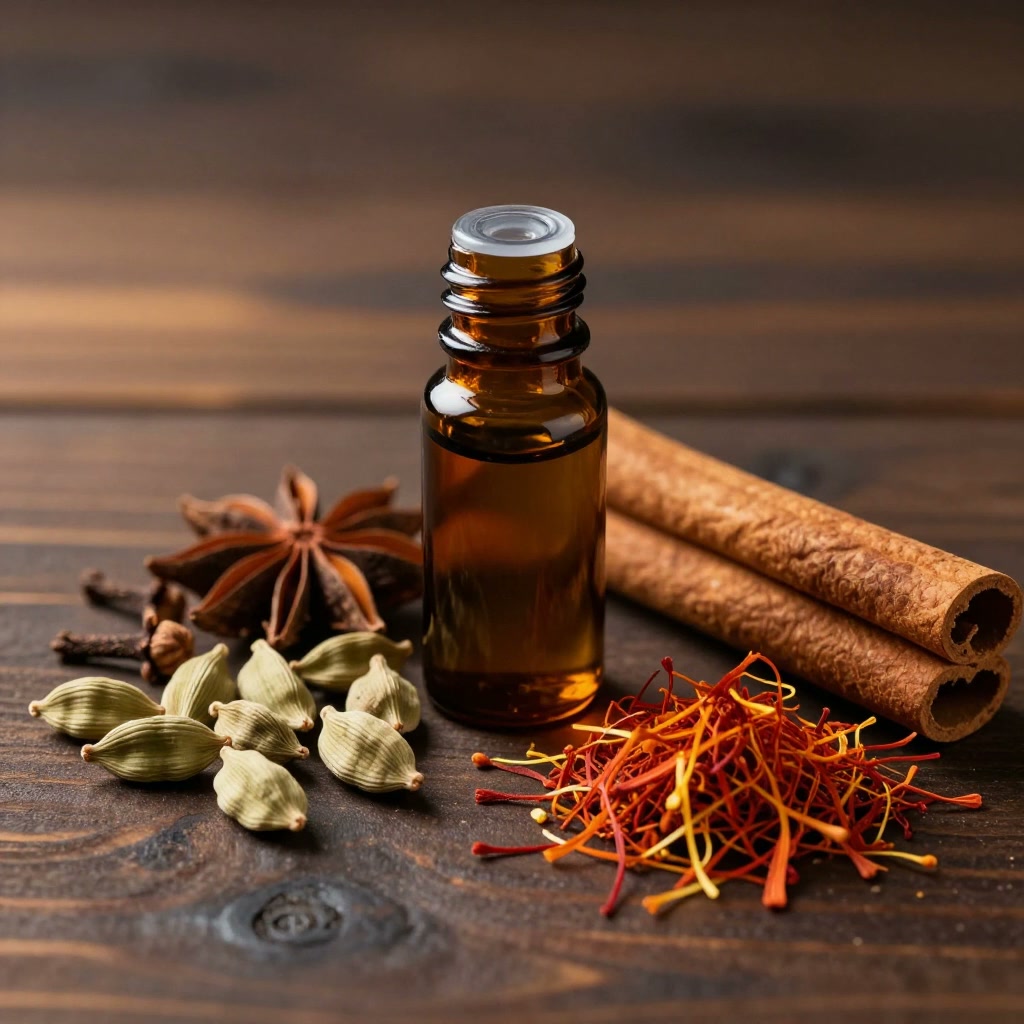
Spice materials tend to be extracted by steam distillation of seeds, bark, or buds (Chapter 14) and carry real culinary overlap, the same compounds doing work in a spice rack and a perfumer's organ. Cardamom is cool, camphoraceous, and slightly eucalyptus-like; clove is warm and intensely spicy, dominated by eugenol (the same compound behind clove's dental-anesthetic use, and one of the materials facing real IFRA restriction covered in Chapter 43); cinnamon splits into bark oil (sharp, hot, more restricted under IFRA) and leaf oil (softer, more usable in fine fragrance); black pepper gives a dry, slightly green sharpness, while pink pepper (botanically unrelated to true pepper, actually a berry) is fruitier and rosier, a favorite modern top-note accent in contemporary niche perfumery.
Saffron's actual aroma compound is safranal, warm and leathery-hay-like, the same material whose correct CAS number and genuine IFRA restriction status were confirmed and fixed on this site's own materials page after independent verification against IFRA's official standard, a real example of the fact-checking discipline Chapter 43's regulatory material depends on being taken seriously rather than assumed.
Lavender is the herb most tightly bound to a single accord: alongside coumarin and a mossy-woody base, it's one of the three defining pillars of the fougere family Chapter 23 covers, and its role there is essentially inseparable from that accord's identity, a fougere without real lavender character barely reads as a fougere at all, no matter how faithfully the rest of the formula follows the structure.
Why does bergamot oil in leave-on skin products often say "FCF" on the label?
What is the real relationship between neroli and orange blossom absolute?
Why is real ambergris still legal to trade in most markets despite most whale products being banned?
Chapter 51, Four More Accords: Woody-Amber, Leather, Aquatic, Green
Chapter 26 walked through six historically foundational accords. Real composition training (ISIPCA's "Advanced Perfumery Composition" module, specifically) keeps going well past those six, the working vocabulary a professional actually needs runs to dozens of named accords, not a handful. Four more that show up constantly in contemporary perfumery, worth knowing at the same level of detail:
The woody-amber accord is arguably the single most commercially dominant accord of the last thirty years, built around Iso E Super (Chapter 42's IFRA correction covers its real restriction status) and Ambroxan, both prized for a smooth, radiant, "clean skin" woody warmth that reads as expensive and modern rather than traditionally resinous, it's the backbone of an enormous share of both niche and mass-market masculine and unisex releases since the 1990s. The leather accord traditionally leaned on real birch tar (smoky, tarry, genuinely leather-like) and isobutyl quinoline, now largely replaced by cleaner synthetic leather-note materials as the harsher traditional birch tar fell out of favor for both regulatory and stylistic reasons.
The aquatic accord, the entire genre Chapter 12's "aquatic 90s" describes, is built almost entirely from Calone (a genuinely synthetic material with no natural equivalent, giving a distinct melon-ozonic "sea breeze" impression) layered with green and marine-adjacent supporting notes; it's a clean example of a major accord with essentially zero natural raw-material tradition behind it at all, unlike every accord in Chapter 26. The green accord, galbanum-forward, sharp, sap-like, traces back to Chapter 12's own Vent Vert lineage and remains the sharpest, most immediately identifiable "cut grass" impression in the entire palette, built on galbanum's genuinely unusual bitter-green chemistry.
Same caveat as Chapter 26: rough teaching skeletons, not real published formulas.
| Accord | Rough skeleton (by weight) |
|---|---|
| Woody-Amber | Iso E Super 50% / Ambroxan 30% / Cedarwood 20% |
| Leather | Synthetic leather note 40% / Birch tar (trace) 10% / Labdanum 30% / Iris 20% |
| Aquatic | Calone 30% / Green marine notes 40% / Musk 30% |
| Green | Galbanum 40% / Green leaf notes 35% / Vetiver 25% |
Chapter 52, Musk: Clean vs Animalic
"Musk" is really two almost-unrelated olfactory territories sharing one name, and confusing them is one of the most common beginner mistakes. Animalic musk, the historic original, from real deer musk (Chapter 49) and its earliest synthetic replacements, the nitro musks, is warm, skin-like, and genuinely a little dirty at close range, the register most classic "sexy" or "sensual" musk fragrances from the 1980s and earlier actually occupy.
Clean musk, built almost entirely from macrocyclic and polycyclic musk molecules developed from the mid-20th century onward, is a completely different impression: soft, powdery, almost soapy, the "fresh laundry" register that defines an enormous share of modern mass-market perfumery, fine fabric conditioner, and body-care products. The two registers share essentially no raw materials in common despite both being called "musk," which is exactly why a fragrance marketed as "musky" can smell warm and animalic in one bottle and crisp and soapy-clean in another with no contradiction at all, they're describing two different accords that happen to share one loose consumer-facing name.
Musk materials are also, unusually, prized specifically for how little they smell like anything distinctive on their own, a genuinely skilled musk selection is judged on its ability to sit underneath an entire formula as a soft, cohesive base (functioning close to the fixation role from Chapter 30) rather than announcing itself, which is part of why musk composition is considered a genuinely advanced skill: doing something so subtle well is harder to judge, and harder to teach, than building a loud, obvious accord.
Chapter 53, From Brief to Formula: A Worked Case Study
This chapter ties Chapters 28 through 31 together into one continuous worked example, the way a real composition module would, rather than leaving each stage feeling separate. Imagine a real-style brief: "A modern woody-amber eau de parfum, unisex, competitive with the Iso E Super-forward niche category, cost ceiling moderate, must clear IFRA at Category 4."
Step one is accord selection, not material selection: the brief points straight at Chapter 51's woody-amber accord as the structural core, which immediately narrows the candidate material list before a single note is chosen. Step two is building the pyramid (Chapter 29) around that core: a citrus-forward top (Chapter 44) to open cleanly, a faceted (Chapter 25) transitional heart, perhaps a soft spicy-woody facet bridging top to base, and the woody-amber accord itself anchoring the base, chosen specifically for the long-wear, skin-like quality the brief's "unisex, modern" language implies.
Step three is the IFRA check the brief explicitly demands (Chapter 19, 43): every candidate material gets checked against its Category 4 leave-on-skin limit before the formula is finalized, not after, catching a restricted-material problem this late in development is far more expensive than catching it here. Step four is dilution and fixation (Chapter 30): the concentrate gets built first at working strength, then diluted to the target eau de parfum percentage, with the woody-amber base itself doing double duty as both the creative core and the fixative anchoring the lighter top notes.
Step five is evaluation (Chapter 31): blotter testing across multiple trial ratios first, then skin testing across several evaluators, since a woody-amber base can read very differently depending on individual skin chemistry (Chapter 4), and only after the formula survives that real evaluation cycle does it move toward the stability and shelf-life testing Chapter 30 also covers, on the long road toward the 18-month-to-3-year commercial timeline Chapter 32 describes. Every stage in this walkthrough is a real, necessary step in actual commercial development, nothing here is simplified away, only compressed into one continuous example instead of five separate chapters.
Skipping straight to materials. Picking "nice-sounding" ingredients before the accord is chosen (step one) usually produces a formula with no real structural core, everything present, nothing anchoring it. Treating the pyramid as three separate accords. A top, heart, and base built in isolation and then simply stacked rarely reads as one continuous idea (Chapter 29); the vertical relationships between layers matter as much as each layer alone. Deferring the IFRA check. Checking restrictions only after the formula "feels finished" is the single most expensive mistake in this whole workflow, a late-stage restricted-material swap can force reformulating an accord that took weeks to balance. Diluting too early. Judging a formula's real character at working strength before it's diluted to the target concentration (Chapter 30) is misleading, since materials don't all scale down at the same rate. Trusting a single evaluation session. One blotter sniff, from one nose, at one moment, is not evaluation (Chapter 31), it's a first impression, and first impressions are exactly what Chapter 4's adaptation and skin-chemistry variation warn against trusting alone.
Write a one-paragraph brief of your own, target consumer, a rough olfactory direction, a competitive set of two or three real perfumes, an IFRA category, a cost tier. Then walk it through the same five steps this chapter just did: which accord (Chapter 26 or 51) does your brief point toward, what would the pyramid's three layers be and why, which materials would need an IFRA check first, how would you dilute and fix it, and what would your evaluation plan actually look like. No formula-building software or real materials required, the value is in forcing every decision to trace back to something specific in your own brief, exactly the discipline a real perfumer works under.
What is the woody-amber accord primarily built from?
What is the key difference between "clean" and "animalic" musk?
Chapter 54, How a Safety Assessment Actually Works

IFRA's restriction numbers (Chapter 19, 43) aren't arbitrary, each one comes out of a real safety-assessment process run by RIFM (the Research Institute for Fragrance Materials), and understanding that process's actual logic makes the numbers themselves far more meaningful than just memorizing a percentage limit.
The core method is a NOAEL, a No Observed Adverse Effect Level, the highest tested dose of a material at which controlled studies find no measurable harm. RIFM's assessment then applies a margin of safety: a large, deliberately conservative safety factor (often 100-fold or more) is divided into that NOAEL to set the actual permitted use level, specifically to account for the gap between controlled study conditions and real-world variability, different skin types, different exposure patterns, sensitive populations, and products used daily over a lifetime rather than in a single controlled test. A material's IFRA limit is therefore no accident of caution; it's a number built with real headroom under the level where any effect was ever actually observed.
Different endpoints get assessed separately and the strictest one wins: dermal sensitization (the risk of developing an allergic reaction with repeated exposure, the driving concern behind materials like Iso E Super's restriction), phototoxicity (reactivity under UV light, the concern behind bergapten in citrus oils, Chapter 44), and systemic toxicity (broader health effects from absorption) are each independently studied, and a material's final permitted concentration in each product category is set by whichever endpoint produces the lowest number, exactly why, as the IFRA Amendment 49 document for OTNE itself states, "such maximum acceptable concentrations correspond to the lowest level obtained per category."
Last reviewed: August 2026.
Chapter 55, Quality Control: Keeping a Batch Consistent
A finished formula being approved once isn't the end of the analytical work, a fragrance house has to prove every subsequent production batch actually matches that approved formula, at industrial scale, indefinitely. This is where GC-MS (Chapter 31) does a second job beyond raw-material identification: batch fingerprinting, running a new production batch through the same instrument and comparing its chromatogram directly against the original approved batch's chromatogram, peak for peak.
A batch that matches closely passes; one with a missing peak, an unexpected new peak, or a meaningfully shifted peak ratio gets flagged before it ever reaches production, catching problems like a supplier substituting a slightly different grade of raw material, a natural material's harvest-to-harvest chemical variation (Chapter 47's vetiver origin differences are a real example of exactly this kind of natural variability a QC process has to account for), or a genuine manufacturing error, all well before a single bottle reaches a shelf.
This same fingerprinting logic extends to the stability testing Chapter 30 introduces: a batch gets sampled and re-run through GC-MS at intervals throughout an accelerated-aging test, specifically watching for new peaks that indicate a material has started degrading or reacting with something else in the formula, turning "does this smell different after six weeks in a hot warehouse" from a subjective question into a measurable, documented one, which is exactly the kind of rigor a real commercial fragrance has to survive before Chapter 32's multi-year path to shelf is considered complete.
What is a NOAEL in fragrance safety assessment?
What is "batch fingerprinting" used for?
Chapter 56, Attar, Oud Culture, and Kōdō
Everything this course has covered up to this point sits mostly inside one lineage: French and Anglo-American fine fragrance, tracing through Grasse (Chapter 8) and the alcohol-based eau de parfum format. That's not the whole story of perfumery, several major, independent traditions developed their own materials, techniques, and even their own definition of what a "perfume" physically is, and a genuinely comprehensive course has to acknowledge them on their own terms rather than as a footnote.
India's attar (ittar) tradition is centered on Kannauj, a city with a documented distillation industry running back centuries, using a technique called deg-bhapka: flowers, spices, or wood are steam-distilled the traditional way, but instead of condensing into water and a separate essential-oil layer the way European distillation does, the aromatic vapor is condensed directly into a base of pure sandalwood oil, which absorbs and carries the scent. The result is an oil-based perfume with no alcohol at all, a genuinely different physical format from everything Chapter 30's dilution chapter describes, built for a climate and a religious context (alcohol-free application matters directly in many Islamic contexts) that alcohol-based Western perfumery was never designed around. This site's own Ain-i-Akbari, a 16th-century Mughal administrative text, documents this attar industry as a real, established economic sector centuries before it reached the West's attention.
The Middle East's oud culture is built around agarwood (Chapter 47) in forms this course hasn't yet covered: bakhoor, chips or a compressed paste of agarwood and other aromatics burned directly as incense rather than extracted into oil at all, filling a room the way a Western candle might but through combustion of the raw material itself; and mukhallat, concentrated oil-based perfume blends (again alcohol-free, for the same reason as attar) that layer oud alongside rose, amber, musk, and spice in combinations a Grasse-trained perfumer would recognize structurally, vertical accords, fixation, layering, while working from an entirely different regional material palette and a different physical delivery format.
Japan's kōdō ("the way of incense") takes the furthest conceptual departure from everything else in this course: it's less a perfumery tradition than a formalized aesthetic and social discipline, alongside tea ceremony and flower arranging as one of Japan's classical "ways." Participants don't wear the scent at all, pieces of aromatic wood, chiefly agarwood, are gently heated (not burned to smoke) and passed in a set order, and participants take turns identifying and discussing the different woods purely through smell, scored in games with names dating back centuries. It's worth sitting with as this course's closing thought on scent itself: every other chapter has treated fragrance as something to build, wear, and sell, kōdō treats it as something closer to a shared meditative art form, purely to be smelled and discussed, never applied to skin at all.
What makes traditional Indian attar physically different from a Western eau de parfum?
What is distinctive about Japanese kōdō compared to every other tradition in this chapter?
Chapter 57, Ibn al-Bayṭār and the Islamic Golden Age Materia Medica
Chapter 6 credits Ibn Sina with the distillation technology essential oils depend on; a different, less commonly told figure from the same broader Islamic Golden Age tradition did the equally foundational work of systematically cataloguing the raw materials themselves. Ibn al-Bayṭār, a 13th-century Andalusian botanist and pharmacologist, compiled one of the most comprehensive materia medica of the pre-modern world, a real, surviving text (digitized and viewable via Gallica, France's national digital library) cataloguing well over a thousand plants, minerals, and animal-derived substances, cross-referencing earlier Greek, Persian, and Arabic sources against his own direct fieldwork traveling across North Africa and the Eastern Mediterranean.
What makes this genuinely relevant to a perfumery course rather than just a history footnote: a real, meaningful fraction of the materials this course covers by name, musk, civet, ambergris (Chapter 49), labdanum, frankincense and myrrh (Chapter 48), sandalwood, appear in his cataloguing with real botanical and geographic detail, centuries before European sources began documenting the same materials with comparable rigor. The Islamic Golden Age's contribution to perfumery isn't limited to one invention (distillation); it includes this quieter, equally essential work of turning scattered folk knowledge into a real, systematic, cross-referenced body of material knowledge, the direct conceptual ancestor of the material-by-material, chemistry-and-origin approach this course's own Part IX takes.
This tradition didn't stay contained to the Islamic world, it's one of the direct routes by which distillation technology and systematic materials knowledge reached medieval Europe, well before Grasse (Chapter 8) became the industry's later commercial center. A straight, documentable line runs from Ibn Sina's alembic and Ibn al-Bayṭār's cataloguing through medieval European monastery distillation, into the Renaissance perfumers Chapter 7 covers, into the industry this entire course describes, a genuinely global lineage that most popular perfume histories compress into a single vague "ancient technique" sentence rather than crediting the specific people and texts actually responsible.
Further reading: Ibn al-Bayṭār's own catalogue is digitized in the Historic Texts library on this site, a real primary source, not a summary of one.
Chapter 58, Sensory Panels and Consumer Testing
Chapter 32 mentions that consumer testing eats a large share of a fragrance's development timeline; this chapter covers what that testing actually looks like methodologically, since "we tested it on people" covers a surprisingly rigorous, statistically real discipline rather than a handful of casual opinions.
A trained sensory panel, a small group of evaluators specifically trained over months to describe scent using a consistent, shared vocabulary rather than personal taste, is used early in development to characterize a candidate formula objectively: how strong is the citrus opening, how long does the base actually persist, does it read closer to woody or amber. This is deliberately kept separate from hedonic testing (whether untrained, ordinary consumers simply like or dislike a scent), since a trained panelist's job is accurate description, not personal preference, mixing the two roles would corrupt both kinds of data.
One specific real method worth knowing: the triangle test, used constantly in the batch-consistency quality control Chapter 55 describes. A panelist is given three samples, two identical, one different, and simply has to identify which one is the odd one out, with no need to describe why. Because the statistical odds of guessing correctly by pure chance are exactly one in three, a triangle test's results can be evaluated with real statistical confidence about whether people can actually detect a difference at all, which is exactly the rigor needed to settle a genuinely contentious question like "does this reformulated batch smell different from the original" with an actual number instead of a subjective argument.
Large-scale hedonic consumer testing, hundreds or thousands of target consumers, sometimes across several international markets since preference genuinely varies by region (Chapter 32 touches this), comes later in development, closer to a final go/no-go decision on a formula a brand is about to commit real production investment to. It's the single most expensive and time-consuming stage of the entire consumer-facing development process, and it's also the stage most likely to send a formula back to the perfumer for real revision even after the creative work felt finished.
Last reviewed: August 2026.
Chapter 59, The Chemistry and History of Synthetic Musks
Chapter 10 covers musk's synthetic origin story (Baur's accidental 1888 discovery while working with explosives) and Chapter 52 covers how clean and animalic musk are used today; this chapter fills in the real chemistry-history connecting the two, three genuinely distinct generations of synthetic musk, each replacing the last for a specific, real reason rather than pure fashion.
The first generation, nitro musks (musk ambrette, musk xylene, musk ketone), dominated through most of the 20th century, cheap, stable, and effective, but eventually found to be both environmentally persistent (accumulating in waterways and wildlife rather than breaking down) and, in some cases, genuinely photoreactive with skin. Musk ambrette and musk xylene are now prohibited under IFRA (Chapter 19, 43) on exactly those grounds; musk ketone remains in use only under a tighter specification.
The second generation, polycyclic musks (Galaxolide and Tonalide are the two most commercially dominant), replaced nitro musks from the 1950s onward with genuinely better environmental and safety profiles at the time, these are the specific molecules responsible for the "clean laundry" musk register Chapter 52 describes, and they remain the highest-volume musk class in the industry today, though some polycyclic musks have since faced their own environmental-persistence scrutiny, an ongoing real regulatory story rather than a settled one. The third generation, macrocyclic musks (large ring-shaped molecules, chemically closer in structure to real natural musk than either synthetic generation before them), are prized for a softer, more "natural-smelling" musk character and better biodegradability, but remain meaningfully more expensive to manufacture, a genuine cost-versus-character tradeoff still playing out in how different price tiers of modern perfumery actually formulate their musk base today.
The throughline across all three generations, and back to the natural deer musk (Chapter 49) they all ultimately replaced: musk chemistry has never stopped evolving in response to real safety and environmental data, the same pattern Chapter 54's safety-assessment logic describes playing out over nearly a century rather than a single review cycle, musk is arguably the single clearest example in all of perfumery of how a fragrance category's chemistry keeps changing under genuine ongoing scientific scrutiny, not fashion.
Last reviewed: August 2026.
What is the statistical basis of a "triangle test" in sensory panel work?
Why were nitro musks largely phased out of modern perfumery?
Chapter 60, Vanilla, in Real Depth
Chapter 20 covers vanilla's sourcing pressure; it deserves the same material-profile depth Part IX gives everything else, since it's arguably perfumery's single most economically important flavor-and-fragrance material at once. Real vanilla comes from the cured seed pods of a climbing orchid, and the curing process is the real story: freshly picked pods have almost no scent at all, the characteristic aroma only develops through weeks of a deliberate sweating-and-drying cycle (alternating sun exposure and enclosed "sweating" in blankets or boxes) that triggers enzymatic reactions converting flavorless precursor compounds into vanillin and dozens of supporting aromatic molecules. A fresh vanilla pod and a properly cured one are, chemically, barely related.
Madagascar (Bourbon) vanilla is the dominant commercial origin, rich and classically creamy-sweet; Tahitian vanilla (a genuinely different species, Vanilla tahitensis, not just a different growing region) is more floral and anise-like, prized separately rather than as a substitute; Mexican vanilla, the original source before French colonial cultivation spread the plant to Madagascar and Réunion, is spicier and less common commercially today than either. Each hand-pollination requirement (Chapter 20) applies identically across all three, the vanilla orchid's specific pollinator bee exists only in its native Mexican range, so every vanilla flower grown anywhere else in the world is pollinated by hand, one flower at a time, within a single-day flowering window.
Vanillin, the dominant single compound behind vanilla's character, was among the earliest aroma chemicals ever synthesized (Chapter 9) and remains, by sheer volume, one of the most-produced flavor and fragrance chemicals in the world, used across chocolate, baked goods, and perfumery alike. But synthetic vanillin alone smells noticeably flatter and more one-dimensional than real cured vanilla, which contains hundreds of trace supporting compounds vanillin alone can't replicate; a genuinely convincing "vanilla" note in fine perfumery is almost always a faceted (Chapter 25) blend of vanillin alongside real vanilla absolute or extract and supporting gourmand materials, not vanillin used alone.
Chapter 61, Trademark, Trade Secrets, and the Law of Smell
A genuinely underrated fact about the entire industry this course describes: in most jurisdictions, including the United States and the EU, a perfume's actual formula cannot be copyrighted. Copyright protects specific creative expression like a written text, image, or piece of music, and courts have generally held that a scent formula is closer to a functional recipe (like a food recipe, similarly uncopyrightable) than a creative work in the legal sense, which is exactly why Chapter 27 mentioned a formula is typically known in full only to the perfumer and a small internal team: legal protection comes from keeping it a genuine trade secret, not from any registered copyright.
This is precisely why "dupe" or "clone" fragrances, products explicitly marketed as smelling like a specific famous perfume, sometimes even naming it in advertising, occupy a genuine legal gray zone rather than being straightforwardly illegal: recreating a smell through independent formulation isn't copyright infringement if no actual trade secret was stolen to do it, and a skilled perfumer genuinely can reverse-engineer a competitor's formula via GC-MS analysis (Chapter 31) without committing any legal violation at all in the process, however commercially controversial the practice remains within the industry.
What can be legally protected, and often is aggressively: the brand name, the bottle's distinctive shape (Chanel No. 5's rectangular bottle and Jean Paul Gaultier's torso-shaped bottle are both real registered trademarks), and specific packaging design, meaning a "dupe" brand can legally approximate a scent but has to build its own distinct bottle and name around it, which is exactly why dupe culture online is full of scent comparisons but essentially never involves literal copies of a famous bottle. The law, in short, protects how a fragrance brand is presented and sold far more tightly than it protects the actual scent itself, a genuinely counterintuitive fact for an industry built entirely around a smell.
Chapter 62, Perfume Criticism as a Discipline
Chapter 35's scent journal builds a personal, private vocabulary; professional perfume criticism is the same underlying skill practiced publicly, at scale, and it developed into a real, recognizable discipline surprisingly recently. Luca Turin, a biophysicist by training, not a perfumer, is the figure most credited with legitimizing serious public perfume writing, beginning with a 1992 book reviewing fragrances with the same seriousness and specificity applied to wine or film criticism, later expanded and co-written with Tania Sanchez into a widely read guide rating thousands of individual releases.
What separates real perfume criticism from casual consumer description is largely the same distinction Chapter 58 draws for sensory panels: a working critic reaches for accord and family vocabulary (Chapters 22-26) rather than vague adjectives, actively tracks a fragrance's development over hours rather than reviewing an opening spray alone, and, critically, writes with enough specificity about actual materials and structure that a reader can compare one review against another and learn something transferable, not just "the reviewer liked it or didn't."
This discipline has migrated heavily online over the past two decades, Fragrantica and Basenotes both host enormous volunteer-written review archives, and a new generation of video and social critics has emerged alongside the original print-era writers, but the underlying standard Turin's early writing established has held: specific, comparative, structurally literate description beats vague enthusiasm, the exact same lesson Chapter 35's scent journal is built to train in a reader working entirely alone, with no audience at all.
Further reading: this site's own perfume database applies exactly this structural, accord-literate approach at scale rather than relying on vague marketing description.
Can a perfume's formula be copyrighted in most jurisdictions?
Why does freshly picked vanilla have almost no scent?
Chapter 63, A Twelve-Week Self-Study Nose-Training Schedule
Everything in Chapters 33-35 is a real tool; this chapter is the missing piece, a schedule that actually sequences them, the way a real program paces daily drills over months rather than handing a student every technique at once and hoping they self-organize. Twelve weeks, roughly 20-30 minutes a day, no lab required.
Printable worksheet (both tables) →
| Weeks | Focus | Track |
|---|---|---|
| 1-2 | Assemble your Tier 1 kit (Chapter 33). Daily: smell each material alone for 30 seconds, eyes closed, before checking the label, build raw recognition first, description second. Log every session (Chapter 35), even a one-line entry. | |
| 3-4 | Stage 1 contrast drills (Chapter 34): pair up your materials and name what specifically separates each pair. Run the full timed-smelling protocol (fresh/15min/1hr/4hr/next day) on at least three materials this fortnight. | |
| 5-6 | Blind self-testing begins: have someone else (or a randomizing trick, shuffle unlabeled blotters face-down) hand you materials from your kit in random order; identify each by nose alone before checking. Track your hit rate week over week, this is the actual measurable progress metric the whole schedule is built around. | |
| 7-8 | Expand to Tier 2 (Chapter 33). Run Carles's binary ratio-trial exercise (Chapter 34's 9:1→5:5 progression) on at least two new material pairs, try a floral against a woody, then a resin against a citrus, and notice how differently the balance point lands each time. | |
| 9-10 | Stage 2 family tables: drill within-family discrimination using your Tier 3 contrast materials. Re-run blind self-tests from weeks 5-6 with your full expanded kit, your hit rate should be visibly climbing. | |
| 11 | Stage 3 deconstruction: pick three finished perfumes you don't already know the notes for, and work through Chapter 36's final-exam questions on each before looking anything up. | |
| 12 | Review your full scent journal from week 1 onward, the actual point of the exercise. Compare your week-1 entries against your week-12 entries on the same materials; the gap between them is the trained nose this whole course has been building toward. Then take the real Academy exam. |
| Phase | Ready to move on when... |
|---|---|
| 1 (wks 1-2) | You can name every Tier 1 material correctly, unprompted, at least 3 out of 4 tries, no rush if it takes longer than two weeks. |
| 2 (wks 3-4) | You can describe, in your own words, at least one specific difference for every pair in your kit, not just "different," a real distinguishing feature each time. |
| 3 (wks 5-6) | Your first blind-test hit rate is established as a real baseline number (whatever it is), the goal here isn't a high score yet, it's having a real number to improve against. |
| 4 (wks 7-8) | You can predict, before smelling the 5:5 blend, roughly where a ratio pair's true balance point will land, even a rough prediction that's directionally right counts. |
| 5 (wks 9-10) | Your blind-test hit rate has measurably improved over your Phase 3 baseline, the specific number matters less than the fact it moved. |
| 6 (wk 11) | You can attempt all of Chapter 36's final-exam questions on an unfamiliar perfume, even if your answers aren't fully correct, completing the reasoning process matters more than getting it right yet. |
| 7 (wk 12) | You can point to at least one specific, concrete difference between your week-1 journal entries and your week-12 entries on the same material, vaguer entries versus specific ones is the actual signal. |
Two honest notes on this schedule. First, it's a floor, not a ceiling, real institute students run drills like this daily for eighteen months to four years, not twelve weeks, and genuine expert-level recognition takes that much longer. Twelve weeks gets you a real, measurable jump in discrimination and vocabulary, not professional-level mastery. Second, the schedule only works if you actually track your hit rate and journal entries, the same discipline Chapter 55's batch-fingerprinting quality control depends on: untracked, un-measured practice feels productive but doesn't reliably compound the way a logged, checkable practice does.
Pick any ten materials, from your own kit (Chapter 33), a friend's collection, or even ten finished perfumes each built around one dominant note. Design a two-week training plan for exactly those ten: what order would you introduce them in (which pairs make the sharpest early contrasts?), where would blind self-testing start, and what would "proficiency" concretely look like by day 14 for this specific set, a hit rate, a specific description each one should reliably produce from you, or both? There's no single correct plan; the exercise is in noticing how many real decisions, sequencing, contrast pairing, what "done" even means, a twelve-week schedule like this chapter's has to make for you by default, once you're forced to make them yourself for a smaller set.
In the twelve-week schedule, what is the actual measurable progress metric the whole program is built around?
Why does the course describe twelve weeks as "a floor, not a ceiling"?
Chapter 64, Composition Studio: Eight Worked Exercises
Chapter 53 walked through one complete brief-to-formula example in depth. This chapter gives eight more, one per major family, in a faster, more scannable format: a one-line brief, a starting ratio (the same kind of illustrative teaching skeleton Chapters 26 and 51 use, not a real published formula), two or three realistic iteration notes, the single most common failure mode for that family, and what a professional would actually adjust next. All eight are fully textual, no materials required, though Chapter 33's kit makes them far more useful to actually attempt.
Brief: a mossy, bittersweet daytime chypre, IFRA-compliant, no oakmoss-allergen overload.
Starting ratio: Bergamot 30 / low-atranol oakmoss base 35 / Labdanum 25 / Patchouli 10.
Iterations: first pass reads thin and mostly citrus; raising labdanum adds depth but tips the accord toward amber instead of mossy-dry; adding patchouli specifically restores the earthy, dry finish that "chypre" actually depends on.
Common failure: leaning on labdanum alone to carry the whole accord, it reads as amber (Chapter 26), not chypre.
A pro adjusts next: the oakmoss-base-to-patchouli ratio specifically, since that's what actually controls dry versus sweet.
Brief: sharp, clean, classic fougère at a low cost ceiling.
Starting ratio: Lavender 40 / Coumarin 30 / mossy-woody base 20 / Bergamot 10.
Iterations: the first pass smells generically "soapy" rather than distinctive; adding a bergamot-forward top gives it real lift; a trace green note (not in the original three) turns out to be needed to stop it reading flat.
Common failure: substituting vanillin for coumarin because they're chemically related, vanillin reads sweeter and loses the dry, hay-like character coumarin actually provides.
A pro adjusts next: coumarin's exact dosage against its real IFRA restriction (Chapter 19) before anything else, since it's a genuinely regulated material.
Brief: warm, enveloping vanilla-amber for evening wear.
Starting ratio: Labdanum 40 / Vanilla 35 / Benzoin 25.
Iterations: the first pass is one-note sweet with no real dimension; increasing benzoin adds balsamic lift; a trace spice (outside the original three materials) keeps it from collapsing into pure dessert territory.
Common failure: overdosing vanilla until the accord reads as gourmand (exercise 7) rather than amber, the two families share real chemistry but aim for a different effect.
A pro adjusts next: the spice trace specifically, since that's the lever that keeps amber and gourmand from blurring into each other.
Brief: an indolic jasmine soliflore that reads sensual rather than heavy, wearable in daylight.
Starting ratio: Jasmine absolute 50 / supporting florals 30 / green top 20.
Iterations: the first pass is too indolic and heavy at full jasmine concentration; diluting the jasmine and adding the green top for lift helps; a trace aldehyde brightens the opening enough to solve the "daylight" part of the brief.
Common failure: assuming more jasmine is always better, a convincing jasmine accord is usually faceted (Chapter 25) from several supporting materials, not built on jasmine alone.
A pro adjusts next: which specific facet, indolic, fruity, or green, should actually lead, since that decision shapes everything else.
Brief: a minimalist, skin-close musk-woody, unisex, deliberately quiet.
Starting ratio: Ambroxan 40 / clean musk 35 / Iso E Super 25.
Iterations: the first pass reads flat and transparent with nothing to grab onto; a tiny citrus trace at the opening gives it a moment of lift; testing at several dilution levels reveals these three materials read very differently concentrated versus diluted, more than most natural materials do.
Common failure: assuming "minimalist" means "use less of everything", Iso E Super and Ambroxan are both loud, diffusive synthetics (Chapter 51) that need careful dosing, not just a smaller ingredient list.
A pro adjusts next: overall dilution level (Chapter 30) as much as the ratio between the three materials themselves.
Brief: a traditional eau de cologne, light and refreshing, short-lived by design.
Starting ratio: Bergamot 35 / Lemon 25 / Orange 20 / Rosemary 10 / Neroli 10.
Iterations: the first pass fades almost immediately, expected for a cologne, but faster than even this brief wants; a small fixative trace extends wear slightly, directly in tension with the "light" brief language.
Common failure: trying to make a cologne "last all day" by loading it with base notes, at that point it stops being a cologne and becomes a different concentration tier entirely (Chapter 37).
A pro adjusts next: exactly how much fixative trace is acceptable before the formula stops being an authentic cologne, a real brief-versus-consumer-expectation tension, not a purely technical one.
Brief: a modern vanilla-praline gourmand, wearable for adults, not cloying.
Starting ratio: Vanilla 40 / praline/caramel accord 30 / Patchouli 30.
Iterations: the first pass reads like dessert rather than perfume; more patchouli grounds it; a bitter, coffee-adjacent trace cuts the sweetness more effectively than reducing vanilla did.
Common failure: treating "not overly sweet" as "use less vanilla", perceived sweetness is usually more about contrast and balance than raw concentration.
A pro adjusts next: which specific bitter or dry material to introduce as a genuine contrast note, not just dialing existing materials up or down.
Brief: a clean, sporty aquatic-green for warm-climate wear, mass-market cost.
Starting ratio: Calone 30 / green marine notes 40 / Musk 30.
Iterations: the first pass is sharp and synthetic-smelling, Calone overdosed reads like a swimming pool rather than "fresh"; cutting it back significantly and bringing musk in earlier than planned smooths the whole accord.
Common failure: overdosing Calone specifically, since it's cheap and highly diffusive (Chapter 51), a little genuinely goes further than it seems like it should.
A pro adjusts next: Calone's concentration specifically, well before touching the other two materials.
In the chypre exercise, what is the most common failure mode described?
In the aquatic-green exercise, which material is most often overdosed by beginners?
Chapter 65, Evaluation Hygiene and Olfactory Fatigue
Chapter 38 covered how to evaluate a finished perfume as a shopper. This chapter covers a narrower, more technical problem every real evaluator, student or professional, runs into constantly: your own nose actively degrades your judgment the longer and harder you use it, in ways that are easy to miss from the inside.
Olfactory adaptation (introduced briefly in Chapter 4) is the real mechanism: receptors exposed to a steady odor stimulus reduce their signal within minutes, which is why a smell that hit you strongly on first sniff can seem to fade or vanish entirely if you keep your nose on it, not because the material evaporated, but because your own sensory system turned its volume down. A related effect, cross-adaptation, means adaptation to one material can dull perception of chemically similar materials too, which is exactly why professional evaluators rotate through multiple blotters rather than repeatedly re-smelling one, and take real breaks, often just clean air, or smelling the back of their own hand or forearm, which stays odor-neutral and gives the nose a genuine reset point between strips.
One widely repeated claim is worth directly addressing: that smelling roasted coffee beans between fragrances "resets" the nose. There's no strong evidence this does anything more than smelling any other single strong, pleasant reference odor, it may offer a brief mental palate-cleanse and something neutral-ish to compare against, but it does not chemically clear receptors or undo adaptation faster than time and clean air do on their own. Treat it as a ritual some evaluators find useful, not a scientifically validated reset button.
A few real, low-cost habits genuinely improve evaluation quality: test no more than three or four materials or formulas in one sitting before adaptation meaningfully compromises judgment; keep testing conditions consistent, same rough time of day, since sensitivity shifts with hunger, fatigue, hormonal cycle, and congestion; label and date blotters immediately, since memory of "which one was which" degrades faster than most people expect; and where a real decision is riding on the result, get a second person's independent read rather than trusting one already-adapted nose. None of this requires equipment, it's discipline applied to a real, well-documented sensory limitation, and it's the difference between a hobbyist's first impression and a trained evaluator's actual assessment.
What does olfactory adaptation actually do to your perception of a smell?
What does this chapter say about the "smell coffee beans to reset your nose" claim?
Chapter 66, One Accord, Three Applications: A Functional Reformulation Case Study
Chapter 42 introduced functional fragrance as its own discipline. This chapter makes that concrete by walking one illustrative starting idea, a lavender, cedarwood, and amber-base concept, roughly the aromatic-fougere territory Chapter 23 and the fougère exercise in Chapter 64 both cover, through three completely different real-world formats, to show how much actually has to change even when the creative idea stays recognizably the same. As with every worked ratio in this course, these are illustrative teaching skeletons, not real published formulas.
Fine fragrance (EDP): the starting concept can be built more or less as written, dosed around 15-20% in perfumer's alcohol, and judged the way Chapter 38 describes, on skin, over hours, watching top-to-base development (Chapter 3). Lavender and bergamot lead the opening, cedarwood and the amber base carry the drydown, and the whole thing is free to be genuinely delicate, since nothing in the format actively fights the fragrance.
Candle: the same concept now has to survive being stirred into wax heated past 60°C without key materials degrading or discoloring the wax, and gets judged on two tests fine fragrance never uses, cold throw (how it smells unlit, straight off the shelf) and hot throw (how strongly and accurately it fills a room once burning). Lavender's delicate top-note character, so valuable in the EDP, often barely survives the heat and burn at all, so a candle version typically leans harder on the cedarwood and amber-base materials that hold up under heat, with a louder, more heat-stable synthetic standing in for some of lavender's contribution rather than relying on the real material alone, the fragrance oil is also usually dosed far higher relative to the product (often 6-10% of total wax weight) than an EDP's alcohol dilution, simply because wax mutes throw so much more than skin does.
Rinse-off shampoo: here the format is actively hostile in a different way, a surfactant base (Chapter 42) can cloud, separate, or strip fragrance oil, and the product is used at a much lower dose (often 0.5-1.5% of the formula) for a much shorter contact time before rinsing. The amber base and cedarwood, both reasonably substantive materials, are chosen partly for how well they survive suspension in surfactant without separating; lavender again struggles to register at all at rinse-off contact times, so a shampoo version often turns to encapsulated fragrance oil (Chapter 42) specifically so a burst of the original lavender-forward opening releases later, under the mechanical friction of towel-drying hair, rather than trying to make the raw material itself register during the brief wash. The creative idea, a fresh, aromatic-woody impression, survives across all three; almost none of the specific technical decisions used to get there do.
Why does a candle version of a fragrance concept typically lean harder on heat-stable materials than delicate top notes?
Why does a shampoo formulation often turn to encapsulated fragrance oil for a note like lavender?
Chapter 67, Four More Worked Exercises: Aldehydic-Floral, Leather, Woody-Amber, Green
Chapters 26 and 51 introduced ten landmark accords as teaching skeletons; Chapter 64 gave eight of them the full worked-exercise treatment, brief, starting ratio, real iteration notes, the most common failure mode, and what a professional adjusts next. This chapter finishes the job for four accords that had a skeleton but never got that same treatment: aldehydic-floral, leather, woody-amber, and green. Same format, same caveat, illustrative teaching skeletons, not real published formulas.
Brief: a classic aldehydic-floral, powdery and sparkling, reading as abstract luxury rather than a literal flower.
Starting ratio: Aldehydes dosed at roughly 8% of the total formula against Rose 30 / Jasmine 30 / Ylang-ylang 20 / a supporting musk base 12.
Iterations: the first pass at a low aldehyde dose just reads like a generic soapy floral; pushing toward the upper end of Chapter 26's 5-10% range is what actually produces the sparkling, abstract signature; too much rose on its own drags it back toward a rose soliflore instead of the intended abstraction.
Common failure: treating aldehydes as a fading top note the way citrus behaves, they're a structural overdose against the whole floral base, not a fleeting accent, so under-dosing collapses the entire accord back into "just a floral."
A pro adjusts next: the aldehyde-to-floral ratio specifically, since that ratio alone is what separates "aldehydic" from "floral."
Brief: a modern, wearable leather accord, smoky-suede rather than harsh, raw birch tar.
Starting ratio: Synthetic leather note 40 / Birch tar (trace) 10 / Labdanum 30 / Iris 20.
Iterations: the first pass at the full birch tar trace reads sharp and almost medicinal; cutting birch tar back to a genuine trace and raising iris softens it into a powdery-suede register that reads "modern leather" rather than "old tannery"; labdanum's resinous warmth turns out to be what keeps the accord from reading thin once the birch tar is pulled back.
Common failure: leaning on birch tar for character instead of trace-dosing it, even a small increase reads smoky and burnt far faster than the brief wants.
A pro adjusts next: the birch tar trace level specifically, since it's the single most disproportionately powerful material in the ratio.
Brief: a clean, modern woody-amber in the commercially dominant register of the last thirty years, radiant and skin-close.
Starting ratio: Iso E Super 50 / Ambroxan 30 / Cedarwood 20.
Iterations: the first pass reads almost too quiet to register; testing at a higher overall dilution rather than adding more material reveals these two synthetics genuinely bloom and grow more present with time and distance, the opposite of how most natural materials behave; cedarwood's role turns out to be adding just enough textured grain to stop the accord reading as pure abstraction.
Common failure: assuming "clean" means using less of everything, Iso E Super and Ambroxan are both loud, diffusive synthetics that need deliberate, careful dosing, the same lesson Chapter 64's clean musk-woody exercise already teaches.
A pro adjusts next: overall dilution and skin-contact testing time specifically, since this accord reveals itself over hours on skin far more than it ever does on a blotter.
Brief: a sharp, true "cut grass" green, kept distinct from an aquatic or floral-green blend.
Starting ratio: Galbanum 40 / Green leaf notes 35 / Vetiver 25.
Iterations: the first pass at full galbanum concentration reads bitter and nearly unpleasant on its own; testing at a much lower overall dose than instinct suggests is what actually reveals galbanum's unusual chemistry, a little reads convincingly "green," while a lot mostly reads "bitter"; vetiver's earthy weight is what keeps the sharpness from feeling thin.
Common failure: overdosing galbanum on the assumption that more equals greener, past a fairly low threshold it stops reading as green and starts reading as simply bitter and vegetal.
A pro adjusts next: galbanum's concentration specifically, well before touching the other two materials, the same lesson Chapter 64's aquatic-green exercise teaches about Calone, applied to a different material.
In the aldehydic-floral exercise, why does under-dosing the aldehydes cause the accord to fail?
In the green exercise, what actually happens when galbanum is overdosed?