 Olfactionary
Historic Texts
A structured path through the craft, not just a book pile, six modules moving from antiquity through Renaissance distillation, the industrial 19th century, the modern chemistry that created today's perfumery, current safety standards, and how regulation actually reshapes real formulas today. Full-text historic works are linked to Project Gutenberg, the Internet Archive, or the Bibliothèque nationale de France (Gallica) rather than copied here, a few of the French-language and Sanskrit texts have no confirmed free English translation and are linked in the original. A handful of essential 20th-century monographs (Arctander's two reference works, Jellinek & Calkin) are still in copyright with no legal free full text available; those are cited with a library-record link rather than presented as readable here.
Recently expanded (September 2026): Mesoamerican and Southern African sources, a real IFRA reformulation case study, public-domain artifact images, and a chronological timeline view.
Browse by author (A–Z) →
Abu'l-Fazl ibn Mubarak (trans. H. Blochmann)
Āʾīn-i Akbarī, Volume I (the imperial perfume department)
Abū al-Qāsim al-Zahrāwī (Albucasis)
Kitāb al-Taṣrīf, Treatise XIX — On Perfumery, Cosmetics, and Aromatic Compounds
Abū Yūsuf Yaʻqūb ibn Isḥāq al-Kindī
Al-Kindi's Book of the Chemistry of Perfume and Distillations
Albert Baur
The discovery of synthetic musk
Alessio Piemontese (trans. William Warde)
The Secrets of Alexis of Piedmont
André Le Fournier
La Décoration d'Humaine Nature et Ornement des Dames
Antoine Hornot (writing as "M. Déjean")
Traité des Odeurs
Arnold J. Cooley
The Toilet and Cosmetic Arts in Ancient and Modern Times
Athenaeus of Naucratis (trans. C. D. Yonge, 1854)
The Deipnosophists, Book XV (On Perfumes)
C. J. S. Thompson
The Mystery and Lure of Perfume
Charles Lillie
The British Perfumer
Dioscorides (trans. John Goodyer, 1655; ed. Robert T. Gunther, 1934)
The Greek Herbal of Dioscorides (De Materia Medica)
Dr. Carl Deite
A Practical Treatise on the Manufacture of Perfumery
ed. M. Padmanabha Marathe Kaeel; Kavikulguru Kalidas Sanskrit University, Ramtek
Gandhaśāstram: A Panoramic View on Cosmetics and Perfumes in Sanskrit Literature
Edmond Roudnitska
Le Parfum
Eduard Gildemeister & Friedrich Hoffmann
The Volatile Oils, Vol. 1
Eduard Gildemeister & Friedrich Hoffmann
Die Ätherischen Öle, Band 2 (The Volatile Oils, Vol. 2)
Eduard Gildemeister & Friedrich Hoffmann (ed.)
The Volatile Oils, Vol. 3
Elisabeth Celnart (trans. Campbell Morfit)
Perfumery, Its Manufacture and Use
Ernest Guenther
The Essential Oils, Vol. I
Ernest J. Parry
The Chemistry of Essential Oils and Artificial Perfumes
Ernest J. Parry
The Chemistry of Essential Oils and Artificial Perfumes, Vol. II
Eugène Charabot & C.-L. Gatin
Le Parfum chez la Plante
Eugène Rimmel
The Book of Perfumes
F. V. Wells & Marcel Billot
Perfumery Technology: Art, Science, Industry
Ferdinand Tiemann & Paul Krüger
The synthesis of ionone
G. W. Septimus Piesse
The Art of Perfumery, and Methods of Obtaining the Odors of Plants
G. W. Septimus Piesse (rev. Charles H. Piesse)
Piesse's Art of Perfumery (5th Edition)
George William Askinson
Perfumes and Their Preparation
Giambattista della Porta
Natural Magick (Magia Naturalis), Book X: Of Distillation
Giovanventura Rosetti
Notandissimi Secreti de l'Arte Profumatoria
Hieronymus Brunschwig (trans. Laurence Andrew)
The Vertuose Boke of Distyllacyon
Hippolyte Dussauce
A Practical Guide for the Perfumer
Hong Chu (洪芻)
香譜 (Xiang Pu / "The Incense Manual")
Hélène Chouliara-Raïos
Le kyphi dans les papyrus grecs
Ibn al-Bayṭār (trans. Lucien Leclerc)
Kitāb al-Jāmiʿ li-Mufradāt al-Adwiya wa-al-Aghdhiya (Traité des Simples)
Ibn Sīnā (Avicenna)
The Canon of Medicine (Al-Qānūn fī al-Ṭibb)
IFRA Standard on Oakmoss Extracts (Amendment 49, 2020)
The Oakmoss Restriction and the Chypre Reformulation Era
International Fragrance Association
IFRA Standards Library
Isabella Cortese
I Secreti de la Signora Isabella Cortese
J. Stephan Jellinek & Robert R. Calkin
Perfumery: Practice and Principles
Jean Carles
A Method of Creation in Perfumery
John Charles Sawer
Odorographia, Vol. I
John Charles Sawer
Odorographia, Vol. II
John H. Snively
A Treatise on the Manufacture of Perfumes and Kindred Toilet Articles
Linda B. Buck & Richard Axel
A Novel Multigene Family May Encode Odorant Receptors: A Molecular Basis for Odor Recognition
Lise Manniche
Sacred Luxuries: Fragrance, Aromatherapy, and Cosmetics in Ancient Egypt
Madame Celnart (Élisabeth-Félicie Bayle-Mouillard)
Nouveau Manuel Complet du Parfumeur
Malcolm Dyson
The Scientific Basis of Odour
Michel de Nostredame (Nostradamus)
Excellent & Moult Utile Opuscule (Traité des Fardemens et Confitures)
Nicholas J. Sadgrove
Southern Africa as a 'Cradle of Incense' in Wider African Aromatherapy
Nicolas Lémery
Traité Universel des Drogues Simples
Otto Wallach
Terpene und Campher
Paul Jeancard
Les Parfums: Chimie et Industrie
Paul Jellinek
The Practice of Modern Perfumery
Pierre-Joseph Buc'hoz
The Toilet of Flora
Pliny the Elder (trans. Bostock & Riley)
Naturalis Historia, Book XIII (Unguents and Perfumes)
Plutarch (trans. Frank Cole Babbitt, Loeb Classical Library)
De Iside et Osiride, §80 (the Kyphi recipe)
R. S. Cristiani
Perfumery and Kindred Arts
Rebecca J. Mendoza
Ritual Relationships with Copal Incense
René-Maurice Gattefossé (ed.)
La Parfumerie Moderne, Vol. 15 (1922)
Roman Kaiser (Givaudan) and Braja Mookherjee (IFF)
Headspace Analysis and the "Living Flower"
Roure-Bertrand Fils (Grasse)
Bulletin Scientifique et Industriel de la Maison Roure-Bertrand Fils
Schimmel & Co. (Miltitz, near Leipzig)
Semi-Annual Report of Schimmel & Co.
Schimmel & Co. (Miltitz, near Leipzig)
Semi-Annual Report of Schimmel & Co. (1904)
Schimmel & Co. (Miltitz, near Leipzig)
Semi-Annual Report of Schimmel & Co. (1906)
Schimmel & Co. (Miltitz, near Leipzig)
Semi-Annual Report of Schimmel & Co. (1910–1911)
Schimmel & Co. (Miltitz, near Leipzig)
Semi-Annual Report of Schimmel & Co. (1913)
Schimmel & Co. (Miltitz, near Leipzig)
Semi-Annual Report of Schimmel & Co. (1917)
Schimmel & Co. (Miltitz, near Leipzig)
Semi-Annual Report of Schimmel & Co. (1918–1920)
Schimmel & Co. (Miltitz, near Leipzig)
Annual Report of Schimmel & Co. (1921–1922)
Simon Barbe
Le Parfumeur François
Sir Hugh Platt
Delightes for Ladies
Steffen Arctander
Perfume and Flavor Materials of Natural Origin
Steffen Arctander
Perfume and Flavor Chemicals (Aroma Chemicals)
Tapputi-Belet-ekallim; tablet transliterated by Erich Ebeling (1919), analyzed by Escobar (2023)
The Tapputi-Belet-ekallim Tablet (KAR 220)
The Good Scents Company
The Good Scents Company Database
Theophrastus (trans. Sir Arthur Hort)
Concerning Odours (De Odoribus)
trans. Cyril P. Bryan (from the German edition)
The Papyrus Ebers
United Provinces of Agra and Oudh government
District Gazetteer of Farrukhabad (the Kannauj scent industry)
Varāhamihira (trans. V. Subrahmanya Sastri & M. Ramakrishna Bhat)
Bṛhat Saṃhitā, Chapter 77 (Gandhayukti)
Wilhelm Haarmann & Ferdinand Tiemann
The synthesis of vanillin
William A. Poucher
Perfumes, Cosmetics and Soaps (Vol. 1: The Raw Materials of Perfumery)
William A. Poucher
Perfumes, Cosmetics and Soaps (Vol. 2: Practical Perfumery, With Especial Reference to Synthetics)
Y. R. Naves & G. Mazuyer (trans. Edward Sagarin)
Natural Perfume Materials: A Study of Concretes, Resinoids, Floral Oils and Pomades
Yuḥannā ibn Māsawayh (Mesuë Senior)
Jawāhir al-Ṭīb al-Mufrada ("Simple Aromatic Substances")
Zhou Jiazhou (周嘉胄)
香乘 (Xiang Cheng / "The Records of Incense")
Établissements Antoine Chiris (Grasse)
Les Parfums de France (as Revue des Marques, Parfums de France)
Ōeda Ryūhō (大枝流芳)
香道滝之糸 (Kōdō Taki no Ito)
1. History & Culture
Context before technique — how scent has been used, valued, and written about.
The Tapputi-Belet-ekallim Tablet (KAR 220)
Why it matters: The earliest named individual chemist on record — a real historical person, not a legend.
The earliest named individual chemist/perfumer on record: a Middle Assyrian cuneiform tablet from the library at Aššur (modern Qal'at Sherqat, Iraq), dated to the 5th year of King Tukulti-Ninurta I's reign, May 1239 BCE. It documents her iterative distillation and filtration methods for perfume-making, using materials including myrrh, calamus, cyperus, and myrtle. No freely reproducible full English translation of the Akkadian text exists online — Ebeling's original 1919 transliteration is in German scholarly journals, not openly digitized. Linked here is the most accessible modern open academic analysis of the tablet rather than a fabricated "translation."
Read more → Academy Ch. 5 →Concerning Odours (De Odoribus)
The earliest surviving Greek treatise dedicated purely to scent — why perfumes fade at different rates, oil versus wine as a carrier for scent, and how compounding creates an effect no single ingredient has alone. Bound with Theophrastus's Enquiry into Plants in this Loeb Classical Library edition.
The Deipnosophists, Book XV (On Perfumes)
A dinner-party dialogue that happens to preserve something no other surviving source does: extended verbatim quotations from lost Greek perfume treatises, including Apollonius (a follower of Herophilus) rating which regions produced the best iris, rose, and other floral extracts. Without Athenaeus, these earlier works — otherwise known only by name — wouldn't survive in any form at all.
Read full text →Naturalis Historia, Book XIII (Unguents and Perfumes)
The Roman naturalist's account of ancient unguent-making, including the twelve principal ingredients of a formal unguent and the famous Royal Unguent of Parthia. This English translation is Volume III of the full Natural History.
The Greek Herbal of Dioscorides (De Materia Medica)
Why it matters: The root of Western raw-material pharmacology — still cited by scholars by name today.
The foundational ancient Greek pharmacological text documenting the processing of balms, myrrh, spikenard, frankincense, and storax — the root of aromatic raw-material knowledge in the West. This scholarly English edition is under a library lending restriction rather than freely downloadable, so it's cited here for reference rather than linked as full text.
Library record →De Iside et Osiride, §80 (the Kyphi recipe)
The fullest surviving ancient description of kyphi, the sixteen-ingredient Egyptian temple incense — honey, wine, raisins, cyperus, resin, myrrh, juniper, cardamom, and more, compounded while sacred texts were read aloud to the perfumers. Egypt's own kyphi inscriptions at the Edfu and Philae temples have no accessible free English translation, so Plutarch's Greek account (itself drawing on Egyptian priestly sources) is the primary text linkable here. See also Academy Chapter 5, and the related Stories piece on scientists recreating a 3,500-year-old Egyptian scent.
Read full text → Academy Ch. 5 → Stories: Scent recreated after 3,500 years →The Papyrus Ebers
Why it matters: Ancient Egyptian medicine and perfumery were the same document — not separate fields.
The great Egyptian medical papyrus (c. 1550 BCE) — alongside its remedies, it records recipes for cosmetic oils, unguents, and fumigations used medicinally, the same aromatic-materials tradition behind kyphi above. Bryan's English translation is the standard accessible edition, but both Internet Archive copies of it are under a library lending restriction (borrow only, not freely downloadable), so it's cited here for reference rather than linked as full text.
Library record →Sacred Luxuries: Fragrance, Aromatherapy, and Cosmetics in Ancient Egypt
Why it matters: The modern scholarly key to actually using the Ebers Papyrus and kyphi sources above.
The modern scholarly companion to the kyphi entry above — Manniche worked directly from Egyptological and pharmacological sources to reconstruct how kyphi and other temple/cosmetic preparations were actually made and used. Still in copyright and under a library lending restriction rather than freely downloadable; cited here for reference.
Library record →
Le kyphi dans les papyrus grecs
A freely downloadable academic article tracing kyphi through Greek-language papyri from Roman Egypt (2nd–4th century CE) — magical recipe papyri, temple account records tracking kyphi purchases for the cult of Harpocrates and Socnopaios, and a private letter (P. Warr. 13) that mentions it in passing. A genuinely different evidentiary trail from the literary sources (Plutarch, the Ebers Papyrus) above — real receipts and working documents rather than descriptive accounts. In French, published in the journal Pallas.
Read full text →Bṛhat Saṃhitā, Chapter 77 (Gandhayukti)
The classical Sanskrit treatise on gandhayukti, the art of compounding fragrances, incenses, and bath oils — includes a combinatorial formula for generating thousands of scent variations from a small set of base materials, a genuinely different formal tradition from every other text in this collection.
Gandhaśāstram: A Panoramic View on Cosmetics and Perfumes in Sanskrit Literature
A modern scholarly survey (All India Oriental Conference Centenary Publication Series) of the Sanskrit gandhaśāstra tradition beyond the Bṛhat Saṃhitā above — including Gangadhara's 12th-century Gandhasāra, the only surviving independent, complete Sanskrit treatise devoted purely to perfumery manufacture. Released CC0 (public domain) by the university itself.
Āʾīn-i Akbarī, Volume I (the imperial perfume department)
The administrative chronicle of Mughal emperor Akbar's court and empire — its household regulations include a dedicated section on the imperial perfume department, documenting attar (distilled fragrant oil) production and the emperor's daily use of scent, incense-burning, and perfumed furnishings. Written in Persian; this is the standard 19th-century English translation, published by the Asiatic Society of Bengal. The Kannauj attar tradition this describes is still practiced today using the same Deg-Bhapka copper-still distillation method.
Academy Ch. 56 →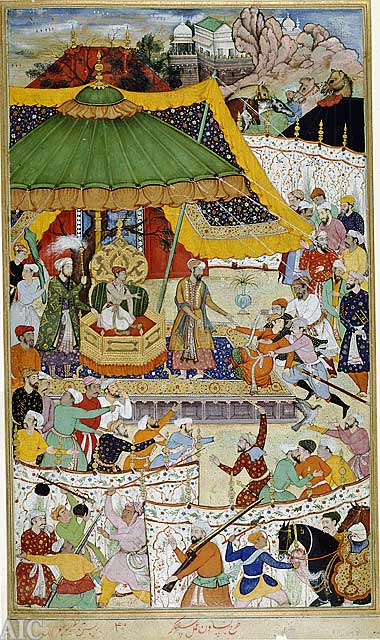
District Gazetteer of Farrukhabad (the Kannauj scent industry)
Three centuries after the Āʾīn-i Akbarī above, this British colonial administrative survey documents Kannauj's attar trade as a living, continuing industry rather than a court institution — real prices ("a half tola phial costs Rs. 25, since a maund of rose leaves produces but one tola of the genuine ítr"), the twenty-odd scents made there besides rose (jasmine, khaskhas, orange, mango), and the inlaid-wood phial boxes sold with them. A rare economic snapshot of the actual working trade, not a description of elite consumption.
香譜 (Xiang Pu / "The Incense Manual")
The earliest surviving systematic Chinese incense manual, predating Xiang Cheng below by over 500 years — organized into the four categories (grades of incense, unusual incenses, historical anecdotes, compounding methods) that every later Chinese incense book, including Xiang Cheng, followed. No public-domain English translation exists; the original classical Chinese is linked here, hosted by ctext.org (Chinese Text Project), an established open academic digital library for early Chinese texts.
Read full text →香道滝之糸 (Kōdō Taki no Ito)
An illustrated two-volume manual of kōdō (香道, "the Way of Incense"), the Japanese incense-appreciation art formalized during the Muromachi period alongside ikebana and the tea ceremony — covering the etiquette, tools, and incense-matching games (kumikō) that structure a kōdō gathering. No public-domain English translation exists; the original Japanese is linked here, freely digitized page-by-page by Waseda University Library's rare books archive.
Read full text →香乘 (Xiang Cheng / "The Records of Incense")
The most comprehensive surviving Chinese incense treatise — 28 volumes covering incense-wood grades, Buddhist and imperial court usage, hundreds of compounding formulas, and accessories, compiled over some twenty years by a Ming-dynasty scholar, expanded from an initial 13-volume 1588 edition. No public-domain English translation exists anywhere, so this links the original classical Chinese text — the imperial 《欽定四庫全書》 (Siku Quanshu) edition hosted by ctext.org (Chinese Text Project), the standard open digital library for classical Chinese texts, with full scholarly front matter and chapter-by-chapter navigation.
Read full text →Notandissimi Secreti de l'Arte Profumatoria
Why it matters: Usually credited as the first book ever printed devoted entirely to perfumery.
Printed in Venice the same year as the Italian original behind the Alexis of Piedmont entry below, but this one is generally credited as the first printed book dedicated entirely to perfumery — over 300 recipes for scented oils, waters, soaps, and pastes, rather than a broader 'book of secrets' that happens to include some. No public-domain digitization has surfaced; cited here via its WorldCat catalog record.
Library record →The Secrets of Alexis of Piedmont
One of the most-translated Renaissance "books of secrets," bridging alchemy and domestic perfumery — recipes for scented waters, pomanders, and civet-based oils, in an early English translation of the 1555 Italian original.
I Secreti de la Signora Isabella Cortese
A women-authored Venetian "book of secrets" mixing alchemy, medicine, and a substantial run of profumeria (perfumery) recipes — one of the few surviving works of this genre with a named woman author. No public-domain English translation has surfaced anywhere (only later German editions exist); the original Italian is linked here rather than force a translation that doesn't exist.
La Décoration d'Humaine Nature et Ornement des Dames
Why it matters: A real historical gap: this book exists, but its own holding library hasn't digitized it.
An early French cosmetic-and-perfumery treatise — recipes for scented waters, powders, soaps, and pomanders, predating Nostradamus's cosmetic work below by a generation. The Bibliothèque nationale de France holds it but hasn't digitized it: its own catalogue record explicitly offers a paid "adopt this book" sponsorship to fund the scan, confirming no free copy exists yet anywhere. Cited here via the BnF catalogue rather than a fabricated link.
Library record →Excellent & Moult Utile Opuscule (Traité des Fardemens et Confitures)
Yes, that Nostradamus — before the prophecies, he worked as an apothecary, and this book of cosmetic and preserve recipes is his other surviving published work. Part one covers fards (cosmetics) and scents for the face. In French only; hosted by the Bibliothèque nationale de France.
Read full text →Delightes for Ladies
An English gentleman's compiled recipe book for scented waters, pomanders, sweet powders, and 'conceits' — aimed at genteel household use rather than trade perfumery, and a useful English-language counterpart to the French and Italian works surrounding it here. This is a later (1632) reprint of the original c.1600–1602 edition.
Le Parfumeur François
The first dedicated French professional treatise written specifically to train apprentice perfumers — scenting gloves, powders, pomades, and distilled spirits. In French only; hosted by the Bibliothèque nationale de France rather than Gutenberg or the Internet Archive.
Read full text →The Toilet of Flora
A translated 18th-century French recipe book of baths, pomatums, powders, perfumes, and sweet-scented waters, aimed at a general lady readership rather than trade perfumers — a snapshot of pre-industrial home perfumery.
Ritual Relationships with Copal Incense
Why it matters: A living Indigenous tradition, not a dead one — copal incense use continues today.
A modern ethnographic and historical study of copal incense — resin from Bursera and Protium trees — as it's actually used today in Indigenous Mesoamerican communities (including Nahua and Maya), read against its documented pre-Columbian ritual role. The clearest open academic entry point this collection has for a tradition entirely outside the Old World lineages that dominate the rest of this module. Openly hosted by Harvard's DASH repository.
Library record →Southern Africa as a 'Cradle of Incense' in Wider African Aromatherapy
Why it matters: Challenges the assumption that incense history runs through the Old World alone.
A modern open-access survey tracing incense and aromatic-plant use across African traditions, arguing Southern Africa's own documented practice deserves a place in the same historical conversation as the Old World incense routes (frankincense, myrrh) covered elsewhere in this module. Published in Scientific African, a fully open-access journal, under a Creative Commons license.
Library record →The Book of Perfumes
Written by the founder of the Rimmel perfume house, a cultural history of scent across ancient Egypt, Greece, Rome, and 19th-century Europe, illustrated throughout.
The Mystery and Lure of Perfume
A later cultural history closing out this module's timeline — the folklore, superstition, and social history of scent, from ancient religious use through Edwardian-era perfumery, illustrated throughout.
2. Raw Materials & Extraction
Where fragrance materials come from, and the classical methods used to get scent out of them.
Jawāhir al-Ṭīb al-Mufrada ("Simple Aromatic Substances")
Why it matters: A full generation before al-Kindī below, and still no free English translation exists.
A generation before al-Kindī below, the Baghdad court physician ibn Māsawayh wrote this treatise covering 29 aromatic substances, centered on the five he considered principal: musk, ambergris, aloeswood, camphor, and saffron. The Arabic manuscript survives (Princeton's Garrett collection holds a copy transcribed in 1194 from a 1030 original), but no public-domain English translation exists — linked here is a freely downloadable, DOI'd modern academic translation-analysis, published in Turkish with the original Arabic passages included.
Read more →Al-Kindi's Book of the Chemistry of Perfume and Distillations
Why it matters: Usually cited as history's very first dedicated perfumery laboratory manual.
A 9th-century Baghdad polymath compiled what's usually cited as the earliest surviving dedicated laboratory manual for perfumers — around 107 practical recipes and alembic-still designs for compounding musks, attars, and early artificial aromatics, roughly a century and a half before Ibn Sina's refinements below. The original Arabic manuscript is public domain, but the standard modern English edition (Martin Levey's 1964 scholarly translation) is still in copyright with no legal free full text available, so it's flagged here as a milestone rather than linked as a readable book — the way this project already treats Baur's and Haarmann & Tiemann's discoveries elsewhere in this timeline.
Read more →Kitāb al-Taṣrīf, Treatise XIX — On Perfumery, Cosmetics, and Aromatic Compounds
Why it matters: Treated cosmetics as real, formal medicine centuries before the West did.
Al-Zahrawi treated cosmetics as its own branch of medicine — 'Adwiyat al-Zinah,' the Medicine of Beauty — and this treatise within his 30-volume encyclopedia covers perfumed compounds and scented sticks pressed in molds, an early antecedent of the modern lipstick. The encyclopedia's famous English translation (Spink & Lewis, 1973) covers only the surgical volume, not this one; no standalone translation or scan of Treatise XIX has surfaced, so it's cited here via the Foundation for Science, Technology and Civilisation's history-of-science write-up of this specific chapter.
Library record →The Canon of Medicine (Al-Qānūn fī al-Ṭibb)
The medical encyclopedia that carried Ibn Sina's refinement of steam distillation — the invention Chapter 6 of Olfactionary Academy is built around — into a text that stayed a standard European medical reference for over five centuries. Distillation and rose-water production are a small part of a vast work, but this is the primary source.
Academy Ch. 6 →Kitāb al-Jāmiʿ li-Mufradāt al-Adwiya wa-al-Aghdhiya (Traité des Simples)
A 13th-century Andalusian-Egyptian botanist's massive alphabetical dictionary of over 1,400 medicinal and food substances, synthesizing Greek, Persian, and Arab sources with the author's own fieldwork across the Mediterranean and Middle East — remained a standard European reference into the 19th century. Covers dozens of perfumery materials (musk, ambergris, storax, ben oil, and more) alongside its wider medical scope. No public-domain English translation exists; linked here is Lucien Leclerc's classic 19th-century French translation, hosted by the Bibliothèque nationale de France.
Read full text →Natural Magick (Magia Naturalis), Book X: Of Distillation
An anonymous 17th-century English translation of the 1589 Italian original — early experimental chemistry on isolating essential oils and tincturing animal musks, civet, and ambergris, presented alongside della Porta's wider (and stranger) natural-philosophy interests.
The Vertuose Boke of Distyllacyon
The first comprehensive printed technical handbook on distillation apparatus and stillroom practice — Middle English spelling throughout ("newly translate out of Duyche into Englysshe"), scanned from the Missouri Botanical Garden's copy via the Biodiversity Heritage Library.
Traité Universel des Drogues Simples
The standard French pharmacological encyclopedia of its era, documenting the botanical origin, adulteration risks, and distillation of aromatic balsams and gums alongside its wider drug catalog. In French only.
The Art of Perfumery, and Methods of Obtaining the Odors of Plants
Piesse's foundational English-language perfumery text, known for proposing that fragrance notes correspond to a musical scale (the "odophone"). Covers maceration, enfleurage, and distillation alongside period handkerchief-perfume formulas.
Piesse's Art of Perfumery (5th Edition)
A posthumous revision of Piesse's 1855 original (above), edited by his son Charles H. Piesse of the firm Piesse & Lubin nine years after the elder Piesse's death. Worth reading alongside the first edition specifically to see the gap between them: this later text folds in synthetic materials like coumarin and heliotropin that simply didn't exist in 1855, showing the trade visibly shifting toward the synthetic era in real time. This edition includes Piesse's "Gamut of Odours" — see the full chart via the link below.
Piesse's Odophone chart →Perfumes and Their Preparation
A practical late-19th-century handbook for commercial perfumers and apothecaries, translated from the third German edition, with formulas for handkerchief perfumes, smelling salts, pomades, and extracts. A dozen of its actual formulas, with real historic quantities, are transcribed and searchable below.
Historical Formula Index →Odorographia, Vol. I
A dedicated, illustrated natural history of raw perfume materials organized by odor family rather than by recipe — chapters on musk, rose, jasmine, violet, vanilla, and more, covering origin, production, and use of each. A two-volume work; the second volume (1894) continues below.
Academy Ch. 15 →Odorographia, Vol. II
The second volume, continuing the odor-family survey of raw materials begun in Volume I.
Perfumes, Cosmetics and Soaps (Vol. 1: The Raw Materials of Perfumery)
The landmark 20th-century industry reference — still cited and updated in later editions today. This first, pre-1929 edition bridges the 19th-century recipe-book tradition and modern industrial perfumery, with systematic coverage of raw materials.
Perfumes, Cosmetics and Soaps (Vol. 2: Practical Perfumery, With Especial Reference to Synthetics)
The companion volume to Vol. 1 above — where that book covers raw materials, this one moves into actual formulation practice and the synthetic aroma chemicals then transforming the industry. This 2nd-edition scan is marked "Full view" (freely readable, not lending-restricted) by HathiTrust, which hosts it rather than Archive.org or Gutenberg.
Read full text →Perfumery and Kindred Arts
A comprehensive American treatise covering the history of perfumes alongside detailed descriptions of the raw materials and processes of the perfumer's trade — broader in scope than most of its contemporaries.
Semi-Annual Report of Schimmel & Co.
One issue of the trade report that was, for decades, the closest thing the essential-oil industry had to shared scientific literature — new isolates, analytical standards, and harvest yields from around the world, printed twice yearly in German, French, and English editions and read by growers, manufacturers, and chemists alike. This is the April/October 1909 English edition; many other years are digitized across the Internet Archive and the Biodiversity Heritage Library.
Semi-Annual Report of Schimmel & Co. (1904)
A different year of the same running trade report as the 1909 edition above — worth having a second, earlier volume specifically because these reports tracked the industry issue by issue: new isolates, adulteration warnings, and shifting harvest yields changed noticeably between 1904 and 1909, and neither single issue tells that story alone.
Semi-Annual Report of Schimmel & Co. (1906)
Another year of the same running trade report, filling in the gap between the 1904 and 1909 issues above.
Semi-Annual Report of Schimmel & Co. (1910–1911)
A combined 1910–1911 edition of the same report.
Semi-Annual Report of Schimmel & Co. (1913)
The last full pre-war edition of the report — the following years' issues visibly show the disruption to international harvests and trade routes that World War I caused.
Semi-Annual Report of Schimmel & Co. (1917)
A wartime edition — read against the 1913 issue above, the disruption to global raw-material sourcing during World War I is directly visible in what the report could and couldn't report on.
Semi-Annual Report of Schimmel & Co. (1918–1920)
A combined edition spanning the war's end and immediate aftermath, bridging directly to the 1921–1922 issue below.
Annual Report of Schimmel & Co. (1921–1922)
A post-World War I edition of the same report, by which point the format had shifted from semi-annual to annual. Useful as a bookend against the 1904 and 1909 issues above — a visible before-and-after across the war years for an industry that depended heavily on international harvests and trade routes.
Bulletin Scientifique et Industriel de la Maison Roure-Bertrand Fils
Why it matters: The actual Grasse house where Jean Carles worked before founding his own perfumery school.
The Grasse house where Jean Carles worked before founding the Roure Perfumery School published this scientific and industrial bulletin tracking new raw materials and research findings. It's cataloged and digitized at HathiTrust rather than freely downloadable in full, so it's cited here for reference.
Library record → Academy Ch. 8 →Les Parfums de France (as Revue des Marques, Parfums de France)
Chiris — the Grasse extraction house where François Coty and Ernest Beaux both trained — published this bimonthly trade journal from 1924 (having started in 1923 as La Parfumerie du Sud-Est), documenting raw-material analytical standards and the firm's colonial-era extraction operations in Algeria, Réunion, and the Comoros. It later merged with the Revue des Marques de la Parfumerie et de la Savonnerie under this combined title; Gallica hosts a browsable run of issues.
Read full text → Academy Ch. 7 → Academy Ch. 8 →Natural Perfume Materials: A Study of Concretes, Resinoids, Floral Oils and Pomades
Why it matters: The mid-century reference for what a 'concrete' or 'absolute' actually is and how it's made.
The mid-century industrial reference on solvent extraction, concrete and absolute yields, and the physical constants of Grasse's floral pomades. Still in copyright and under a library lending restriction rather than freely downloadable; cited here for reference.
Library record →The Essential Oils, Vol. I
The most exhaustive multi-volume botanical and chemical survey of essential oils ever published — this first volume covers history, plant origin, production, and analysis. Marked public domain by its uploader; several of the later volumes in Guenther's six-volume set are separately digitized on the Internet Archive as well, though this project has only independently verified this one's open access status.
Academy Ch. 15 →3. Formulation & Composition
Recipes and structural thinking — the closest 19th-century perfumery came to a "how to actually build a scent" text.
Traité des Odeurs
A pre-Revolutionary French guide to alcohol-based perfumes, scented vinegars, pomades, and complexion preparations for the Parisian nobility, presented as a sequel to the same author's treatise on distillation. In French only.
Read full text →The British Perfumer
An early-19th-century English perfumer's trade guide of formulas drawn from thirty years of practice, covering perfumery, snuff, and colourman's work — a rare look at the commercial trade a generation before Piesse systematized it.
Nouveau Manuel Complet du Parfumeur
Celnart's original French manual, first published in 1834 as part of the Librairie Encyclopédique de Roret's technical-manual series — recipes for oils, pomades, cosmetic creams, colognes, and perfumed waters aimed at both the perfumer-manufacturer and the perfumer-tradesman. In French only; this scan is a later (1854) Roret printing of the same original text, digitized from the New York Public Library's copy and freely readable on Google Books.
Perfumery, Its Manufacture and Use
The English translation, adapting Celnart's recipes for an American manufacturing audience — one of the earliest technical perfumery books printed in the United States.
The Toilet and Cosmetic Arts in Ancient and Modern Times
A sweeping reference spanning ancient and modern beauty practice, with hundreds of formula variations, ingredient adulteration checks, and cultural context alongside the pure perfumery content.
A Practical Guide for the Perfumer
A technical manual blending French perfumery methodology (Dussauce trained under the chemist Michel-Eugène Chevreul in Paris) with the growing 19th-century American chemical trade, with over a thousand formulae.
A Treatise on the Manufacture of Perfumes and Kindred Toilet Articles
Why it matters: A real 1877 book that, as far as this project has found, was simply never digitized.
An American pharmacist's guide to handkerchief extracts, pomatums, sachet powders, and tinctures — a real, catalogued 1877 Nashville imprint. It's not digitized on Project Gutenberg or the Internet Archive as far as this project has found, so it's cited here via its library catalog record rather than linked as full text.
Library record →A Practical Treatise on the Manufacture of Perfumery
A technical, chemistry-focused manual translated from the German, covering volatile oils, resins, adulteration testing of raw materials, and fruit ethers — including its own "Compound Odors (Bouquets)" chapter of real named formulas (Jockey Club among them), transcribed and searchable below.
Historical Formula Index →La Parfumerie Moderne, Vol. 15 (1922)
René-Maurice Gattefossé's own trade journal — the chemist later known for coining "aromatherapy" published his working formulas, revisions, and industry news serially here rather than only in his hard-to-find 1912 pamphlet. This is one openly-licensed volume; the Bibliothèque interuniversitaire de santé and Internet Archive host many other years of the same run.
A Method of Creation in Perfumery
The single most influential document in modern perfumery education, by the perfumer behind Ma Griffe and Miss Dior — the paper that formalized the contrast-then-family-table-then-deconstruction training method described in Chapter 34 of Olfactionary Academy. Originally published in the Soap, Perfumery and Cosmetics Yearbook.
Academy Ch. 34 →Le Parfum
Why it matters: The closest perfumery has to a real philosophical aesthetic theory of scent.
The other major figure of 20th-century French perfumery pedagogy alongside Jean Carles above — Roudnitska (creator of Diorella and Eau Sauvage) wrote the field's most serious attempt at a genuine aesthetic theory of scent, in the Que sais-je? pocket-encyclopedia series. No free translation or scan exists in any language; still in copyright, cited here via its OpenLibrary catalog record for reference.
Library record →Perfumery Technology: Art, Science, Industry
Why it matters: Bridges Jean Carles-era craft technique with modern industrial-scale production.
Billot (founding president of the Société Française des Parfumeurs) and Wells bridge Jean Carles-era formulation technique with modern industrial cosmetic, soap, and aerosol compounding. Still in copyright; cited here for reference.
Library record →4. Chemistry of Aroma Materials
How perfumery shifted from purely natural extraction to synthetic chemistry — the discoveries that made whole fragrance categories possible for the first time.
The Chemistry of Essential Oils and Artificial Perfumes
A bridge between classical plant extraction and modern synthetic perfumery, with chemical breakdowns of individual essential oils and early synthetic isolates.
The Chemistry of Essential Oils and Artificial Perfumes, Vol. II
The companion volume to the 1899 edition above, from a later, expanded printing — hundreds of pages given over specifically to the chemical isolation of individual aroma compounds (geraniol, linalool, citral, the ionones) right as synthetic perfumery was becoming a mature discipline rather than a novelty.
Academy Ch. 17 →Le Parfum chez la Plante
Charabot pioneered phytochemistry at Grasse — this is the botanical-chemistry explanation for how and why a living plant actually manufactures volatile aromatic oils in its own cells during growth, a level below "which flower smells like what" that most perfumery texts never touch. In French only.
Terpene und Campher
Wallach's own 600-page summary of the research that won him the 1910 Nobel Prize in Chemistry — working out the actual molecular structure of terpenes, limonene, pinene, and camphor. This is the chemistry that turned perfumery's raw materials from empirically-known substances into structurally-understood ones. In German only.
The Volatile Oils, Vol. 1
A landmark chemistry reference produced by Schimmel & Co, one of history's great essential-oil houses — exhaustive coverage of the chemical composition, production, and analysis of essential oils, the standard scientific reference of its era.
Die Ätherischen Öle, Band 2 (The Volatile Oils, Vol. 2)
The middle volume of the same standard reference as Vol. 1 and Vol. 3 here, continuing the species-by-species survey of essential oils. No English translation of this volume appears to have been digitized anywhere — Kremers' English edition covers Vol. 1, but Vol. 2 is only findable in the original German. Included here in German rather than skipped entirely.
The Volatile Oils, Vol. 3
The third volume of the same standard reference above, continuing the systematic chemical survey of essential oils. Digitized by the Digital Library of India rather than a Western institution — a reminder that a meaningful share of this material's surviving digitization work has happened outside the US and Europe.
Les Parfums: Chimie et Industrie
Captures the Golden Age of Grasse-era perfumery formulation at its industrial peak — extraction solvents and synthetic isolates as they stood right before the modern era. In French only; hosted by the Bibliothèque nationale de France rather than Gutenberg or the Internet Archive.
Read full text →Perfume and Flavor Materials of Natural Origin
Why it matters: Still the book working perfumers actually keep on their desk today, decades later.
The reference every working perfumer still keeps within reach for natural raw materials — over 500 monographs covering physical properties, processing, evaluation, and adulteration. Still in copyright and not freely available in full; cited here for reference.
Library record →Perfume and Flavor Chemicals (Aroma Chemicals)
Why it matters: 3,102 individually numbered synthetic materials — the synthetic-side companion to the book above.
The companion two-volume encyclopedia of synthetic aroma chemicals — 3,102 numbered monographs covering odor, threshold, structure, and use. Still in copyright and not freely available in full; cited here for reference.
Library record →The Scientific Basis of Odour
Why it matters: A real rival theory of smell — molecular vibration, not shape — decades ahead of its time.
The founding paper of the vibrational theory of olfaction — Dyson proposed the nose detects an odorant's molecular vibrational frequency (via Raman shift) rather than its shape, decades before the theory resurfaced in modern quantum-biology research. Published in the Journal of the Society of Chemical Industry; behind a publisher paywall, so cited here for reference rather than linked as full text.
Library record →The synthesis of vanillin
Why it matters: Made vanilla's dominant aroma compound affordable at industrial scale for the first time.
Haarmann and Tiemann synthesized vanillin from coniferin, patenting the process in 1874. It made vanilla's dominant aroma compound affordable at industrial scale for the first time, and the company Haarmann founded on it (later Haarmann & Reimer) became one of the industry's foundational fragrance and flavor houses.
Read more → Academy Ch. 9 →Headspace Analysis and the "Living Flower"
Why it matters: Let perfumers finally capture what a living, uncut flower actually smells like.
Roman Kaiser pioneered headspace analysis at Givaudan starting in the early 1970s — trapping and analyzing the volatile compounds a living, uncut flower actually releases, rather than the different (and often quite unlike) profile you get from extracting or distilling the cut plant. Mookherjee's IFF Living Flower Technology, commercialized and patented around 1990, is the best publicly documented landmark of the technique reaching industrial fragrance creation. Linked here is the actual US patent — patents are public record by design, so this is a genuinely free primary document rather than a paywalled paper.
Read more →The synthesis of ionone
Why it matters: Made violet and iris-type notes viable outside the luxury tier for the first time.
Tiemann and Krüger synthesized ionone — the violet-scented compound — via aldol condensation of citral and acetone. Before this, violet-flower oil was among the most expensive materials in perfumery; the synthetic version made violet and iris-type notes viable in mainstream fragrance for the first time.
Read more → Academy Ch. 9 →The discovery of synthetic musk
Why it matters: Discovered by accident, while researching more effective explosives — not perfume.
Baur discovered nitro musk compounds by accident while researching more effective forms of TNT, patenting the process in Germany the same year (DRP No. 47599). It launched the entire category of synthetic musks that perfumery still relies on, since natural musk (from the musk deer) was scarce, expensive, and is now restricted on animal-welfare grounds.
Read more → Academy Ch. 10 →5. Modern Reference & Regulation
Not historical — the living standards and databases the industry actually uses today.
IFRA Standards Library
The fragrance industry's own safety body publishes usage limits and restrictions for individual fragrance materials, searchable and free to browse. This is current, actively maintained reference material, not a historical text.
View standards → Academy Ch. 19 → Academy Ch. 43 → Materials Prohibited by IFRA → Materials Restricted by IFRA →The Good Scents Company Database
A free, no-registration database of thousands of flavor and fragrance materials — odor descriptions, CAS numbers, and usage data, actively maintained since 1994. The closest thing the industry has to a shared public reference library for individual materials.
View standards →A Novel Multigene Family May Encode Odorant Receptors: A Molecular Basis for Odor Recognition
Why it matters: The actual Nobel-winning paper this course's entire first chapter is built on.
The paper behind Academy Chapter 1 — cloning the first odorant receptor gene family, the discovery that won Buck and Axel the 2004 Nobel Prize in Physiology or Medicine. Published in Cell (Elsevier); predates NIH's open-access mandate, so no free full text is legally hosted anywhere — cited here via its PubMed record rather than linked to a paywalled or pirated copy.
Library record → Academy Ch. 1 →Perfumery: Practice and Principles
Why it matters: The standard academic textbook practicing perfumers still reference today.
The standard academic textbook on perfume formulation architecture, evaluation methodology, and the psychology of smell — still in copyright and not freely available in full; cited here for reference.
Library record → Academy Ch. 21 →The Practice of Modern Perfumery
Why it matters: An early, direct ancestor of the fragrance wheel used throughout this site.
J. Stephan Jellinek's father: introduced the Odor Effects Diagram (mapping fragrances along erotic/calming/exalting/refreshing axes) in the original 1949 German edition — an early, direct ancestor of the modern fragrance wheel (Chapter 21). Still in copyright and under a library lending restriction; cited here for reference.
Library record →6. Documented Reformulation Case Studies
Not historical texts, but a living case study of how regulation actually reshapes real formulas — no fabricated recipes here, since modern commercial formulas are trade secrets. Real regulatory documents and real named perfumers on the record.
The Oakmoss Restriction and the Chypre Reformulation Era
IFRA's standard caps oakmoss extract — the mossy base tying together classic chypre fragrances like Guerlain's Mitsouko and Shalimar — over the allergens atranol and chloroatranol, requiring each below 100 ppm within the extract, following the tighter 2008 Amendment 43. Guerlain's in-house perfumer Thierry Wasser has spoken publicly about reworking Mitsouko's oakmoss accord in response, in an interview widely reported to call it one of the few genuinely successful reformulations in the category — read against the industry's more mixed record covered in the Washington Post's 2021 report on fragrance safety rules ("Perfume makers sniff at new safety regulations"). Linked here is the actual current IFRA standard, not a retelling of it.
Read the standard → Academy Ch. 19 → IFRA Standards Library →